Productivity Guilt: A Hidden Struggle for Therapists


Productivity guilt is the feeling of inadequacy that arises when you perceive your efforts as falling short, even if you’ve been working tirelessly. It’s the voice in your head that says, You should have done more today. It stems from the pressure to achieve, perform, and constantly improve, even when you’re already stretched thin.
For therapists, this guilt can manifest in several ways:
- Feeling like you’re not doing enough for your clients, even when they’re making progress.
- Overcommitting to administrative tasks, such as documentation or outreach.
- Struggling to set boundaries around your work hours.
- Comparing your productivity to that of your peers.
Why Are Therapists Prone to Productivity Guilt?
The nature of the profession makes therapists particularly susceptible to this type of guilt. Here are a few reasons why:- The Pressure to Help Others: Therapists enter this field because they genuinely want to make a difference. When clients struggle or progress feels slow, it’s easy to internalize responsibility, even though healing is a complex and non-linear process.
- Blurred Boundaries: Therapy isn’t a 9-to-5 job. There’s always another note to write, another client to prepare for, or another training to attend. Without clear boundaries, it’s easy to feel like you’re never truly off the clock.
- Perfectionism: Many therapists hold themselves to high standards, striving to be the best possible practitioner. While this drive can lead to excellence, it also fuels unrealistic expectations and self-criticism.
- Societal Narratives About Productivity: In our culture, busyness is often equated with worth. Therapists, like anyone else, can fall into the trap of believing that being constantly busy is a sign of value and success.
The Impact of Productivity Guilt
Unchecked productivity guilt can take a significant toll on your well-being. It can lead to:- Burnout: Chronic feelings of inadequacy and overwork can drain your energy and passion for the profession.
- Reduced Effectiveness: When you’re constantly pushing yourself, your ability to be present and effective with clients may diminish.
- Mental Health Challenges: Feelings of guilt and inadequacy can contribute to anxiety, depression, and low self-esteem.
You don’t have to be perfect to be effective. Showing up with care and authenticity is more than enough. Click here to download a bonus chapter on guilt from Toxic Productivity, where you can get strategies to combact productivity guilt for you and your clients.
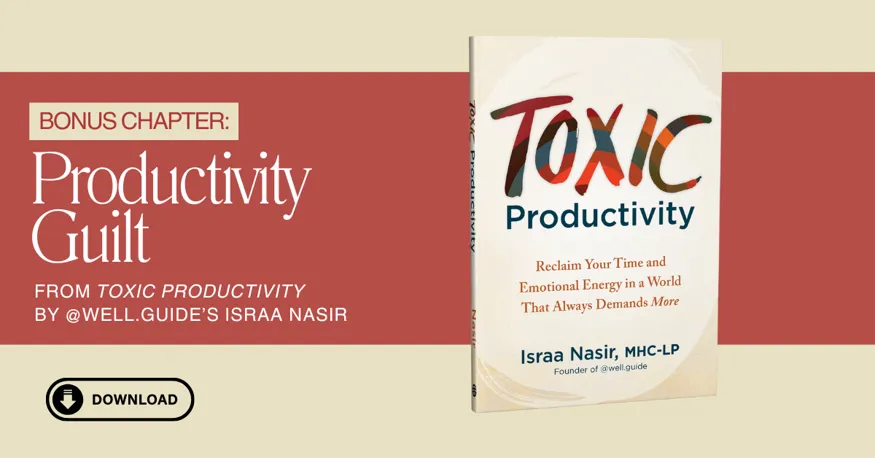

In this timely and unsparing guide, psychotherapist and @well.guide founder Israa Nasir offers research-backed insight on dynamics such as self-worth, shame, social comparison, burnout, and perfectionism that keeps us always busy but never satisfied. Nasir gives expert and tangible guidance so you can separate who you are from what you do.


As the founder of Well.Guide, a global mental health platform with over 350,000 followers, Israa has led thousands of people in rethinking the role of productivity in their lives. She is known for translating complex psychological concepts into actionable, relatable guidance, and her work has been featured in Time, Forbes, Harvard Business Review, and Psychology Today.
Drawing from her clinical experience with ambitious, high-performing clients, Israa brings a nuanced, culturally responsive lens to therapy. She helps clinicians understand the hidden emotional toll of overachievement and offers evidence-based interventions to support clients struggling with burnout, people-pleasing, and chronic “doing.”
Through her teaching, Israa blends therapeutic insight, cultural context, and lived experience to create trainings that are emotionally resonant, clinically practical, and deeply human.
Speaker Disclosures:
Financial: Israa Nasir has an employment relationship with Anise Health. She receives royalties as a published author. Israa Nasir receives a speaking honorarium and book royalties from PESI, Inc. She has no relevant financial relationships with ineligible organizations.
Non-financial: Israa Nasir has no relevant non-financial relationships.
Text Callout Headline
Text Callout description BoxText Callout description Box Text Callout description Box Text Callout description Box Text Callout description Box

Headline Text
Featured Product Callout

Learn how to do trauma-informed, therapeutic yoga sessions in-person & online. Gain clinical tools from somatic therapy, polyvagal theory, Parts Work and more.


Quick process to streamline paperwork, overcome documentation challenges, maximize insurance payments and updated DSM-5® considerations for every disorder.

Learn powerful tools to treat early wounds, shame, and low self-worth with experts Lindsay Gibson & Kelly McDaniel.
Product Promo Cards Headline



Featured Product Cards Headline

Hubspot Form
Hubspot Description goes here.
This is the headline for the accordion block
Description
Card inner content 1
Card inner data 2
Simple View Headline
Featured Event Cards Headline
RTE Block has a lot of text so that we can see what it looks like, maybe we just want to write some stuff and see what happens?


This is a test of the blog content blocks
