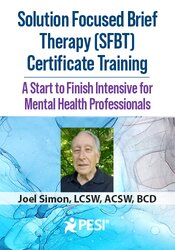
Get everything you need to confidently use Solution Focused Brief Therapy (SFBT) in this 2-day training.
- Perfect for anxiety, stress, depression or relationship issues
- Proven interventions you can use immediately
- Demonstrations and hands-on exercises so you’ll know what to do in sessions
Your clients don’t just want to cope and deal with problems.
They want solutions that quickly move them toward the life they want.
But so many approaches pull clients backward, focusing on problems, pathology, and past events instead of exploring the future they hope to create.
That’s where Solution Focused Brief Therapy (SFBT) give you something other therapies don’t.
Proven, practical tools that shift therapy away from problems and help clients take meaningful steps toward what they want rather than what they fear or feel stuck in … whether you’re working with anxiety, chronic stress, depression or relationship issues.
Now in this training you can learn how to use SFBT to create momentum, build hope, and catalyze change within just a few sessions …
You’ll watch Joel Simon, LCSW, ACSW, BCD – founding member of the Solution Focused Brief Therapy Association - who has taught thousands how to facilitate rapid transformation using SFBT.
Through step-by-step instruction, demonstrations and exercises he’ll show you how to use SFBT tools to create “wins” in therapy that fuel confidence, hope and rapid progress by helping clients see their strengths, lean into what’s already working, and focus on what’s possible instead of what’s wrong …
There’s no jargon. No confusion. Just clear, effective strategies you can apply with your very next client.
This training is sure to bring immediate value to your practice – maybe even transform how you think about therapy.
PLUS you’ll earn your Solution Focused Brief Therapy Certificate, letting clients and colleagues know you’ve completed this extended training.
Purchase now!