DVD

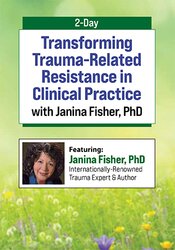
2-Day Transforming Trauma-Related Resistance and Stuckness

$459.99 Standard
Also Available: Digital Seminar

Trauma treatment is invariably complicated by the fact that most traumatic experiences involve incompetence or cruelty perpetrated by other human beings. Thereafter, even loved ones no longer feel safe: they feel threatening

Coming to therapy is a cry for help, requiring vulnerability.

But being offered help has often come to be associated with powerlessness, manipulation, and humiliation. Even when clients sincerely want something different for themselves, they cannot control the triggering of instinctive survival defenses, nor the fact that each survival response is inherently in conflict with another. Should the client commit to therapy or flee? Combat the therapist’s every effort? Or “submit” by coming but not fully participating?

In this workshop, you will explore the complex relationships between these internal trauma-related conflicts and resistance in psychotherapy. Using techniques drawn from Sensorimotor Psychotherapy, Internal Family Systems, and other mindfulness-based psychotherapy models, participants will learn how to de-code resistance and help clients become aware of their therapy-related conflicts and resistance as a normal aspect of trauma treatment.

What we clinicians often label “resistance” may reflect inherent trauma-related conflicts activated by all forms of treatment and all types of therapists. Resistance can manifest in any of the following ways:

  • A passive aggressive ‘no’ to every therapeutic intervention
  • Unchecked self-destructive behavior
  • A struggle for therapeutic control
  • Desperation for help alternating with resistance to accepting it

Purchase today! You have a chance to become part of the solution instead of part of the problem.

Here's What You'll Learn


DAY ONE

What do we mean by resistance and stuckness?

  • Depression, shame, self-loathing
  • Chronic suicidality or self-destructive behavior
  • Belief that nothing will work
  • Difficulty coming to or being present in therapy
  • Struggles for control of the process
Therapy as a threat, not a refuge
  • Phobias of vulnerability
  • Phobias of closeness or being visible
  • Phobias of abandonment and distance
  • Trauma-related fear and mistrust
How manifestations of stuckness and resistance reflect animal defenses
  • Survival responses and strategies
  • Introduction to the Structural Dissociation Model
  • Understanding resistance and stuckness as defensive, not offensive
How we interpret resistance may increase, not decrease it
  • Triggering aspects of psychotherapy
  • Decreasing the ‘threat’
  • Positively re-framing stuckness and resistance as adaptive
  • Acknowledging and sharing the dilemma: the client wants help but not at the cost of vulnerability
Using the therapeutic relationship
  • Navigating the threat of closeness and the threat of distance
  • Making use of the “social engagement system”
  • Therapeutic benefits of laughter and playfulness

DAY TWO

Helping clients deconstruct inner conflicts and struggles

  • Making use of the Structural Dissociation Model in therapy
  • Helping clients understand internal conflicts as struggles between parts
  • Using the language of parts to articulate and highlight contradictory behavior
  • Honoring the parts who defend by resisting
Increasing client ability to observe trauma-related patterns
  • Introducing mindfulness as a therapeutic tool
  • Increasing curiosity and interest
  • Using psychoeducation to challenge existing beliefs and patterns
”Befriending” the resistance
  • Letting go of our need for the client to change or engage
  • Facilitating empathy for parts who defend and parts that feel injured
  • Re-framing resistance and stuckness as “the parts,” not the whole of the client
  • Cultivating compassionate internal relationships
Creative solutions for old and obsolete survival strategies
  • ”Negotiated settlements” with defender parts
  • Internal soothing and comfort for hurt and fearful parts
  • Therapeutic support for resistance and acceptance of stuckness
  • Creating a sense of “we” that includes the parts who collaborate and the parts who resist as well as the therapist
Healing the wounds of the past
  • Providing ‘missing experiences’ of healthy attachment
  • Therapy as a play space: balancing permissiveness and structure
  • ”Being” the therapeutic relationship instead of talking about it
  • Enjoying the struggles rather than resisting them

Everything You're Getting


  • More than 12 hours of content
  • CE information to come
  • Handouts and resources

We Recommend


This Item

Will be added to the cart.
2-Day Transforming Trauma-Related Resistance and Stuckness
DVD
$459.99

Meet Your Experts


Janina Fisher, PhD

Toggle speaker biography

Janina Fisher, PhD, is a licensed clinical psychologist and former instructor at The Trauma Center, a research and treatment center founded by Bessel van der Kolk. Known as an expert on the treatment of trauma, Dr. Fisher has also been treating individuals, couples, and families since 1980.

She is past president of the New England Society for the Treatment of Trauma and Dissociation, an EMDR International Association Credit Provider, Assistant Educational Director of the Sensorimotor Psychotherapy Institute, and a former Instructor, at Harvard Medical School. Dr. Fisher lectures and teaches nationally and internationally on topics related to the integration of the neurobiological research and newer trauma treatment paradigms into traditional therapeutic modalities.

She is co-author with Pat Ogden of Sensorimotor Psychotherapy: Interventions for Attachment and Trauma (2015) and author of Healing the Fragmented Selves of Trauma Survivors: Overcoming Internal Self-Alienation (2017) and the forthcoming book, Working with the Neurobiological Legacy of Trauma (in press).


Speaker Disclosures:
Financial: Dr. Janina Fisher is an international expert and consultant on Trauma and Dissociation. She is a consultant for Khiron House Clinics and the Massachusetts Department of MH Restraint and Seclusion Initiative. Dr. Fisher receives royalties as a published author. She receives a speaking honorarium, recording royalties and book royalties from Psychotherapy Networker and PESI, Inc. Dr. Fisher has no relevant financial relationships with ineligible organizations.
Non-financial: Dr. Janina Fisher is on the advisory board for the Trauma Research Foundation. She is a patron of the Bowlby Center.

100% Satisfaction Guarantee

Register for this intensive training course without risk. If you're not completely satisfied, give us a call at 800-844-8260.

We’re that confident you'll find this learning experience to be all that's promised and more than you expected.

PESI App


Access CE trainings on your phone or tablet through our free mobile app. Choose video or audio-only versions of online courses from the world's best instructors, and complete your CE requirements anywhere, anytime, at your own pace.


Access for Self-Study (Non-Interactive)

Access never expires for this product.

Questions?

Visit our FAQ page at www.pesi.com/faq or contact us at www.pesi.com/info

Want this training for your whole team?

Get a customized training package for your team at a discounted rate!


Media Type:
DVD
Also Available:
Digital Seminar
Product Code:
RNV057965
Duration:
12 hours, 28 minutes
Copyright:
Jun 09, 2021
Publisher:
PESI Inc.

ADA Needs


We would be happy to accommodate your ADA needs; please call our Customer Service Department for more information at 1-800-844-8260.

Some text some message..
Back to Top