Many therapists like you have tried strategy after strategy when working with the underlying causes of childhood trauma…
…you support your young clients through flashbacks that come without warning, shame loops, hopelessness, bodily pain and resistance – yet you can’t seem to alleviate the root cause of their trauma.
Working with kids with acute or complex trauma has no linear roadmap, so choosing the right path to treatment based on your client’s needs is crucial for real change.
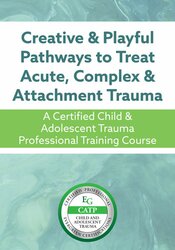
Watch Dana Wyss PhD, LMFT, ATR-BC, who has over 25 years in trauma work in this Certification Course in Trauma and Attachment Treatment for Children and Adolescents. Dana will provide you creative and evidence-informed interventions and a new way to work with kids suffering from acute to complex developmental trauma.
In this certification you’ll learn:
- To identify trauma’s internal impact and brain functions related to survival instincts
- Techniques and group discussion to identify and respond to fight, flight, freeze as well as fear, frustration, manipulation, and intimidation
- To help kids identify safe people and relationships, even when their trust gauge is broken
- Strategies to help yourself and your young client before, during, and after moments of crisis through sensory-based and expressive activities to maintain healthy orienting systems
- Pros and Cons of picking the right evidence-based practice for you and your young client
- Tangible and expressive activities to go deeper into your trauma work with children and adolescents
Best of all, upon completion of this training, you’ll be eligible to become a Certified Child and Adolescent Trauma Professional (CATP) through Evergreen Certifications.
Professional standards apply. Visit www.evergreencertifications.com/CATP for details.
Purchase today, get the proven tools and techniques needed to end the suffering of your clients and move them from surviving to thriving!
CERTIFICATION MADE SIMPLE!
- No hidden fees – PESI pays for your application fee (a $99 value)*!
- Simply complete this training and the post-event evaluation included in this training, and your application to be a Certified Child and Adolescent Trauma Professional through Evergreen Certifications is complete.*
*Attendees will receive documentation of CATP designation from Evergreen Certifications upon completing consultation.
*Professional standards apply. Visit www.evergreencertifications.com/CATP for professional requirements.