Real clients don’t fit into simple diagnostic categories. And when clients come in with multiple issues, it’s easy to fall into the “what do I treat first” trap.
But what if you could learn ONE protocol that gets to the heart of what creates suffering in every client with an emotional disorder, regardless of diagnoses?
Developed by Dr. David Barlow at Boston University, the Unified Protocol (UP) cuts across traditional diagnostic boundaries to focus on key psychological processes underlying most mental health issues. Leave behind the confusion and frustration of chasing treatment order or switching between approaches – with the UP, you will simultaneously reduce symptoms of co-occurring disorders, all while improving your clients’ quality of life.
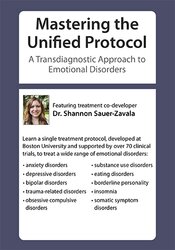
In this workshop, Dr. Shannon Sauer-Zavala, co-developer of the UP, will walk you through 8 easy-to-learn modules and demonstrate how you can use UP principles flexibly to:
- Harness your clients’ motivation toward change
- Teach your clients to better understand and utilize the power of their emotions
- Facilitate cognitive restructuring exercises to enhance the clarity of your clients’ thinking and deciding
- Revamp your clients’ mistaken appraisals of triggering body sensations
- Improve your clients’ ability to be present and in charge of their behaviors
Rooted in the power of emotion-focused CBT and shown to be effective in over 70 rigorous clinical trials, the Unified Protocol lets you get to the core of mental health issues and focus on your client - not labels.