nat's test headline - pesi cms
Digital Seminar
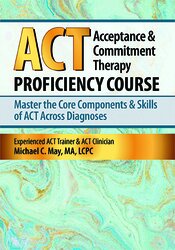
Acceptance & Commitment Therapy (ACT) Proficiency Course

Acceptance & Commitment Therapy (ACT) Proficiency Course

Standard - $249.99 $132.49 Anniversary Sale 2026 - 47% off!

This Acceptance and Commitment Therapy (ACT) Proficiency Course recording is essential for any clinician with a difficult-to-treat client on their caseload!

ACT has long been established as effective in treating clients with a variety of clinical diagnoses.

Now, you can master the core competencies and skills used by ACT clinicians!

Watch ACT expert and clinician, Michael C. May, MA, LCPC, and he’ll walk you step-by-step through using the six core processes of Acceptance and Commitment Therapy in session. For each of the six components, you’ll learn interventions and strategies that you can use in your practice immediately.

You’ll have plenty of opportunities for practice through in-depth case studies and targeted experiential exercises – allowing you to really hone your skills.

Clinicians new to ACT will find this course transparent and easy to understand, while experienced ACT clinicians will discover new, in-depth insights that will solidify comprehension of ACT concepts and expand your repertoire of ACT interventions.

Here's What You'll Learn


ACT Foundations: What You Need to Know
  • Context: Why it is Fundamental to ACT
  • How to determine the functional purpose of behavior
  • What is language: Relational Frame Theory
  • The source of psychological suffering
  • The ACT model of psychopathology
  • Experiential avoidance, cognitive fusion & the toxic cycle
  • Psychological Flexibility: What it is & why it’s important
  • The Inflexahex diagnostic model
  • Limitations of the research & potential risks

THE CORE CONCEPTS OF ACT

Acceptance: Combat Experiential Avoidance

  • What is “acceptance” in ACT?
  • Experiential avoidance: The “Control Agenda”
  • Client control over unwanted thoughts & feelings
  • How to confront the control agenda
  • Interventions for fostering acceptance
  • Acceptance Exercises: The “Unwanted Party Guest;” “Barriers to Writing”
Defusion: Break Down Thoughts as Barriers
  • The problem with cognitive fusion
  • Weaken unworkable language functions
  • Should thoughts always control behavior?
  • Build an environment of defusion within session
  • Strategies for building defusion skills
  • Defusion Exercise: “Having vs Believing” our thoughts
Self-As-Context: Aid Clients in Distancing Themselves from Their Thoughts
  • What is self-as-context?
  • Self-as-content vs. self-as-context
  • Mitigate attachment to the conceptualized self
  • Help clients understand self-as-context
  • Interventions to foster self-as-context
  • Self-As-Context Exercise: The “observer self”
Contact with the Present Moment: Mindfulness Strategies to Reduce Worry about the Past & Future
  • Mindfulness: A core feature of all human psychopathology
  • What “mindfulness” means in ACT
  • The goal of mindfulness practice in ACT
  • How to train mindfulness with flexibility
  • Overcome obstacles in teaching mindfulness
  • Address relaxation-induced panic
  • Formal & informal mindfulness interventions
  • Contact with the Present Moment Exercise: Mindfulness without Meditation
Values: Guide Clients in Identifying & Clarifying What Matters
  • The importance of values in ACT
  • How values can be transformative in human behavior
  • Values & goals
  • How to evoke values from clients
  • From instant gratification to pursuit of values
  • Values Clarification Exercise: The Eulogy
Committed Action: Establish Values-Consistent Patterns of Behavior
  • The relationship between values & committed action
  • What’s considered committed action?
  • Address persistent inaction, impulsivity or avoidance
  • Interventions
    • Exposure-based approaches
    • Behavioral activation strategies
    • Social-skills training interventions
    • Problem-solving barriers to committed action
    • Behavioral homework
  • Case Study: Engaging in committed action with depression
ACT in Action: Utilize ACT with Specific Clinical Populations
  • PTSD
  • Anxiety
  • Personality disorders
  • Depression

Everything You're Getting


  • More than 6 hours of video content
  • CE information to come
  • Handouts and resources

We Recommend


This Item

Acceptance & Commitment Therapy (ACT) Proficiency Course
Will be added to the cart.
Acceptance & Commitment Therapy (ACT) Proficiency Course
Digital Seminar
$132.49
$249.99

Meet Your Experts


Michael C. May, MA, LCPC

Toggle speaker biography

Michael C. May, MA, LCPC is a psychotherapist in private practice and an ACT Trainer. He is a founding partner of Compassionate Psychological Care, LLP, a clinic that provides a wide-range of psychological services with offices in Chicago and Highland Park, IL.  Within his private practice, his clinical work is focused on anxiety-related presenting concerns, primarily Panic Disorder and Obsessive-Compulsive Disorder. Michael is also co-founder of Enriched Couples LLC, a company focused on utilizing applied behavioral science in conjunction with financial literacy training to aid young couples in undermining toxic experiential avoidance and building vital and valued relationships.

Michael has received advanced training in various contextual behavioral approaches to psychotherapy including Acceptance & Commitment Therapy (ACT) and Dialectical Behavioral Therapy (DBT) and regularly provides workshops and professional trainings on Acceptance & Commitment Therapy. Michael is a Licensed Clinical Professional Counselor in the State of Illinois.  He is a member of the Association for Contextual Behavioral Science and the Association for Behavior Analysis International.


Speaker Disclosures:
Financial: Michael May is the founder of Compassionate Behavioral Healthcare, LLC and the founding & managing partner of Compassionate Psychological Care, LLP. He is the co-founder of Enriched Couples, LLC. Michael May receives a speaking honorarium and recording royalties from PESI, Inc. He has no relevant financial relationships with ineligible organizations.
Non-financial: Michael May is a member of the Association for Contextual Behavioral Science and the Association for Behavior Analysis International.

100% Demo Guarantee

Register for this intensive training course without risk. If you're not completely satisfied, give us a call at 800-844-8260. We're that confident you'll find this learning experience to be all that's promised and more than you expected.

PESI Mobile App


Access CE trainings on your phone or tablet through our free mobile app. Choose video or audio-only versions of online courses from the world's best instructors, and complete your CE requirements anywhere, anytime, at your own pace.


Access for Self-Study (Non-Interactive)

Access never expires for this product. For a more detailed outline that includes times or durations of time, if needed, please contact cepesi@pesi.com.

Questions?

Visit our FAQ page at www.pesi.com/faq or contact us at www.pesi.com/info

Claim your FREE listing


Need referrals? List your practice in the directory for FREE!


Media Type:
Digital Seminar
Product Code:
POS055310
Duration:
6 hours, 21 minutes
Copyright:
Dec 11, 2019
Closed Captions:
Available
Format:
Audio and Video

ADA Needs


We would be happy to accommodate your ADA needs; please call our Customer Service Department for more information at 1-800-844-8260.

Some text some message..
Back to Top