
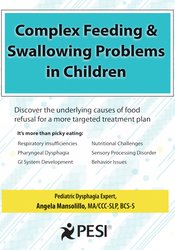
Complex Feeding & Swallowing Problems in Children
Discover the Underlying Causes of Food Refusal for a More Targeted Treatment Plan
- Speaker:
- Angela Mansolillo, MA/CCC-SLP, BCS-S
- Duration:
- 5 Hours 56 Minutes
- Format:
- Audio and Video
- Copyright:
-
Nov 01, 2019
- Product Code:
- POS020004
- Media Type:
- Digital Seminar

Description
Developing a Menu for Success
The causes of feeding and swallowing difficulties in children are always multifaceted, sometimes misdiagnosed, and often difficult to assess and treat appropriately.
Respiratory difficulties, gastrointestinal function, oral-motor skills, and behavioral issues are just a few of the elements that can influence feeding and swallowing, limit response to treatment, and result in significant health issues.
To maximize effectiveness, clinicians must resist the temptation to assess and treat feeding and swallowing disorders in isolation; instead, they must develop management plans that take into account interactions between and among oral-motor, gastrointestinal, and respiratory systems.
This essential course recording describes complex feeding and swallowing disorders as they manifest themselves in children who have a variety of diagnoses.
Attendees gain successful strategies for identification of the underlying etiology of the dysphagia. The evidence base for specific therapies, including oral-motor techniques, behavioral interventions, nutritional interventions, and strategies for respiratory control, are evaluated.
Arm yourself with practical suggestions and tactics for improving function in these challenging children, as well as strong evidence to support those strategies!
Credit
Speaker

Angela Mansolillo, MA/CCC-SLP, BCS-S Related seminars and products
Angela Mansolillo, MA/CCC-SLP, BCS-S, is a speech-language pathologist and board-certified specialist in swallowing disorders with more than 30 years of experience. She is a senior speech-language pathologist at Cooley Dickinson Hospital in Northampton, Massachusetts where she provides evaluation and treatment services for adults and children with dysphagia and is involved in program planning and development including quality improvement initiatives, patient education, and clinical policies and protocols. She is also adjunct faculty at Elms College Department of Communication Sciences and Disorders in Chicopee, Massachusetts and a guest lecturer in the Department of Communication Disorders at the University of Massachusetts. Over the course of her career, she has worked in a variety of clinical settings with children and adult populations with a career-long focus on feeding and swallowing disorders. Recently, she authored Let’s Eat!: A Clinical Guide to the Management of Complex Pediatric Feeding and Swallowing Disorders. Angela is a recent recipient of the Massachusetts Speech and Hearing Association’s Award for Clinical Excellence and is a sought-after speaker for both live and online continuing education courses as she seamlessly blends current research with clinical experience.
Speaker Disclosures:
Financial: Angela Mansolillo has an employment relationship with Elms College and Cooley Dickinson Hospital. She is a consultant with Dysphagia Services and receives speaking honorarium from ContinuEd, Medbridge, Advantage CE, and Dilgem Continuing Education. Angela Mansolillo receives a speaking honorarium, recording, and book royalties from PESI, Inc. She has no relevant financial relationships with ineligible organizations.
Non-financial: Angela Mansolillo is a member of ASHA.
Additional Info
Access for Self-Study (Non-Interactive)Access never expires for this product.
Questions?
Visit our FAQ page at www.pesi.com/faq or contact us at www.pesi.com/info
Objectives
- Examine the interplay between oral-motor, gastrointestinal, and respiratory systems and their impact on food refusal in children in order to expand volume and variety of intake.
- Analyze the signs and symptoms of pharyngeal dysphagia in children to prevent aspiration associated illnesses.
- Evaluate advantages and challenges associated with dietary modifications and use of thickened liquids with a goal of increasing safe oral intake.
- Apply rationale for various dietary recommendations currently being implemented with children in order to separate fact from fiction about special diets.
- Determine the pros and cons of various oral-motor & sensory treatment approaches to maximize safe, pleasurable eating and drinking in children.
- Develop a behavioral treatment plan to address problem feeding behaviors including food refusal, limited food repertoire, low volume of intake, and rigidity around foods and utensils.
Outline
RESPIRATORY SYSTEM DEVELOPMENT AND FUNCTIONS
- You Can’t Eat If You Can’t Breathe
- Breathing/Swallowing Coordination and Discoordination
- Role of pulmonary clearance
- Aspiration and aspiration pneumonia
- Incorporate respiratory indicators in evaluation
- Exercise Interventions for breathing/ swallow discoordination and respiratory insufficiencies
PHARYNGEAL DYSPHAGIA
- Clinical assessment matters!
- Instrumental assessment options
- Improving pharyngeal swallow function
- Interventions to decrease aspiration risk
- Dietary modifications – texture modifications and thick liquids pros and cons
- Oral hygiene
- Interactive case review – What your client’s gut is telling you
GI SYSTEM DEVELOPMENT
- GI system and respiration connection
- Reflux and Reflux Disease
- Constipation
- Allergies
- Dietary and lifestyle interventions
- Food allergies and the gut
- Positioning and sleep
ORAL MOTOR FUNCTION
- Postural stability matters
- Oral muscles are not skeletal muscles
- Exercise Interventions - are they right for your client
SENSORY PROCESSING AND EATING – CAN’T HAVE ONE WITHOUT THE OTHER
- Food as therapy
- The role of taste and smell
- Strategies – how to expand food repertoire
WHEN IT REALLY IS BEHAVIOR
- What’s the behavior’s form AND function
- Examining the feeding environment
- Finding the right reinforcement strategy
- Behavioral intervention in 5 steps:
- Environment, hunger, reinforcement, shaping and parent training
- Interactive case review – when it’s behavior…but not just behavior
WEANING FROM TUBE FEEDING
- Priming the Gut
- Rapid vs. Gradual weans
- Blended diets
- Strategies for Tube Feed Weaning
- Blended diets – when and who
MORE NUTRITIONAL INTERVENTIONS for Pharyngeal Dysphagia, GI Development, Oral Motor Function, Sensory Processing, Behavior and Tube Feeding
- Nutrition and immune system function
- Supplements
- Which special diets are really special
- Techniques to improve nutrition
Target Audience
- Speech-Language Pathologists
- Speech-Language Pathology Assistants
- Occupational Therapists
- Occupational Therapy Assistants
- Dieticians
- Dietary managers
- Physical therapists
- Nurses
- Early Childhood Special Education Staff
- Other Helping Professionals who Work with Children
Reviews
| 5 |
|
| 4 |
|
| 3 |
|
| 2 |
|
| 1 |
|
Overall: 5
Total Reviews: 16
Satisfaction Guarantee
Your satisfaction is our goal and our guarantee. Concerns should be addressed to: PO Box 1000, Eau Claire, WI 54702-1000 or call 1-800-844-8260.
ADA Needs
We would be happy to accommodate your ADA needs; please call our Customer Service Department for more information at 1-800-844-8260.
PESI Mobile App
Access CE trainings on your phone or tablet through our free mobile app. Choose video or audio-only versions of online courses from the world’s best instructors, and complete your CE requirements anywhere, anytime, at your own pace.




Please wait ...