
Digital Version Available
Get immediate lifetime access to this content by purchasing the digital seminar/online course instead that you can access using a variety of devices, and one CE certificate is included with purchase! Click the “Digital Seminar” or "Online Course" link below to learn more!
DVD Purchasers please note: In order to view the content, you will be required to have a DVD player or a DVD drive on your computer. Your CE is a separate fee.
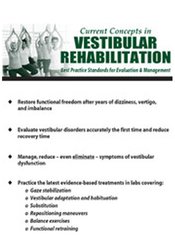
Current Concepts in Vestibular Rehabilitation: Best Practice Standards for Evaluation & Management
- Speaker:
- Chris Carpino, MPT
- Duration:
- 5 Hours 06 Minutes
- Copyright:
-
Mar 20, 2015
- Publisher:
- PESI Inc.
- Product Code:
- RNV020025
- Media Type:
- DVD

Description
Be the First & Last Stop for Vestibular Patients Seeking Help
Dizziness is one of the most common complaints heard by primary physicians, but the reasons contributing to dizziness are numerous and often difficult to diagnose, ranging from age and medication side effects to trauma and infection. These vertigo symptoms can, at times, be the limiting factor for mobility, keeping patients from freely and safely walking around their homes or going out into the community. Vestibular Rehabilitation is highly effective in the reduction and elimination of balance disorders and vertigo. It is the most successful treatment of the most common cause of vertigo over medication or surgery. The ultimate goal of treatment is to eliminate a person's risk for falling.
During this recording, you will learn differential diagnostic techniques that identify the contributor of a patient's dizziness. You will understand the pathophysiology of the dizziness and treat the condition accordingly. In addition, laboratory components which analyze patients' compensatory functional movement patterns and balance strategies will be reviewed. The lecture and lab components presented will be helpful for treating a variety of disorders, including Benign Paroxysmal Positional Vertigo (BPPV) and chronic vertigo, as well as balance and proprioceptive disorders. Upon completion of this recording, you will be confident in applying the best interventions to improve your patients' balance regardless of the demographic or work environment.
Credit
Speaker
Chris Carpino, MPT Related seminars and products
CHRIS CARPINO, MPT, is a licensed physical therapist practicing in southern New Jersey, and specializes in Vestibular Rehabilitation. Mr. Carpino has completed Vestibular Competency training at Emory University and achieved certification in Vestibular Rehabilitation from the American Institute of Balance in Largo, Florida. He is currently developing the vestibular program at Bayada Home Health, with staff training and marketing. Mr. Carpino is an adjunct instructor at Burlington County College, where he teaches Anatomy and Physiology. He received his Bachelor of Science degree in Exercise Science from James Madison University in Harrisonburg, Virginia. He obtained his Master of Physical Therapy degree from Richard Stockton College in Pomona, New Jersey. Currently, Mr. Carpino practices in southern New Jersey, where he treats patients of various orthopedic and neurological diagnoses. His strengths in rehabilitation include orthopedics, vestibular rehabilitation and manual therapy. Mr. Carpino's goal as a clinician is to utilize all of his skills to treat the patient as a whole, not just the symptoms.
Speaker Disclosures:
Financial: Chris Carpino has an employment relationship with Bayada Home Health Care. He receives a speaking honorarium from PESI, Inc.
Non-financial: Chris Carpino is a member of the America Physical Therapy Association, Neurology Section.
Additional Info
Access for Self-Study (Non-Interactive) Access never expires for this product.Questions?
Visit our FAQ page at www.pesi.com/faq or contact us at www.pesi.com/info
Target Audience
- Physical Therapists
- Physical Therapist Assistants
- Occupational Therapists
- Occupational Therapy Assistants
- Audiologists
- Physicians
Objectives
- Identify and implement treatment strategies for dizziness caused by BPPV
- Evaluate and diagnose central and peripheral vertigo
- Demonstrate steps to conduct a detailed oculomotor analysis
- Perform manual canalith repositioning techniques
- Perform functional balance assessment and treatment
- Understand the epidemiology of dizziness and falling
- Develop personalized treatment regimens to address specific vertiginous and imbalance systems
- Understand the pathophysiology of common vestibular disorders
- Apply anatomy and physiology principles as they relate to the vestibular complex and balance systems
Outline
INTRODUCTION TO VESTIBULAR REHABILITATION
- Epidemiology of dizziness and falling
- Role of the vestibular system and its contribution to daily activity
ANATOMY & PHYSIOLOGY OF THE VESTIBULAR SYSTEM
- Vestibular complex
- Peripheral and central components
- Balance systems
- Proprioceptive, visual, and vestibular
- Motor control and strategies
PATHOPHYSIOLOGY & CLINICAL PRESENTATION OF VESTIBULAR DISORDERS
- Unilateral/bilateral vestibular loss
- Benign paroxysmal positional vertigo (BPPV)
- Perilymphatic fistula
- Superior semicircular canal dehiscence
- Meniere’s disease and migraines
- Concussion
- Transient ischemic attack (TIA)/cerebrovascular accident (CVA)
- Cervical vertigo
- Orthostatic hypotension
DIAGNOSTIC TESTS & EVALUATION PROCEDURES
- Differentiate central vs. peripheral vestibular pathology
- Oculomotor exam
- Spontaneous and gaze-holding nystagmus
- Smooth pursuit and saccades
- Visual acuity
- VOR cancellation
- Vertical and horizontal nystagmus
- Torsional nystagmus
- Positional testing
- Roll test
- Vestibular function testing
- ENG and VNG
- Cervical and ocular VEMPs
- Subjective visual vertical
- Caloric and rotary chair testing
- Balance testing
TREATMENT PROGRESSION LAB
- Berg and DGI
- TUG (standard, manual, cognitive)
- Gait assessment
- Gaze stabilization
- X1 and X2 viewing
- Vestibular adaptation and habituation
- Canalith repositioning techniques
- Anterior, posterior, and horizontal canals
- Apiani and Cassani maneuvers
- Liberatory and Brandt-Daroff maneuvers
- Cervical exercises
- Static and dynamic balance exercises
- Functional retraining
- Self-treatment and HEP
CASE STUDIES
Reviews
Satisfaction Guarantee
Your satisfaction is our goal and our guarantee. Concerns should be addressed to: PO Box 1000, Eau Claire, WI 54702-1000 or call 1-800-844-8260.
ADA Needs
We would be happy to accommodate your ADA needs; please call our Customer Service Department for more information at 1-800-844-8260.
PESI Mobile App
Access CE trainings on your phone or tablet through our free mobile app. Choose video or audio-only versions of online courses from the world’s best instructors, and complete your CE requirements anywhere, anytime, at your own pace.




Please wait ...