
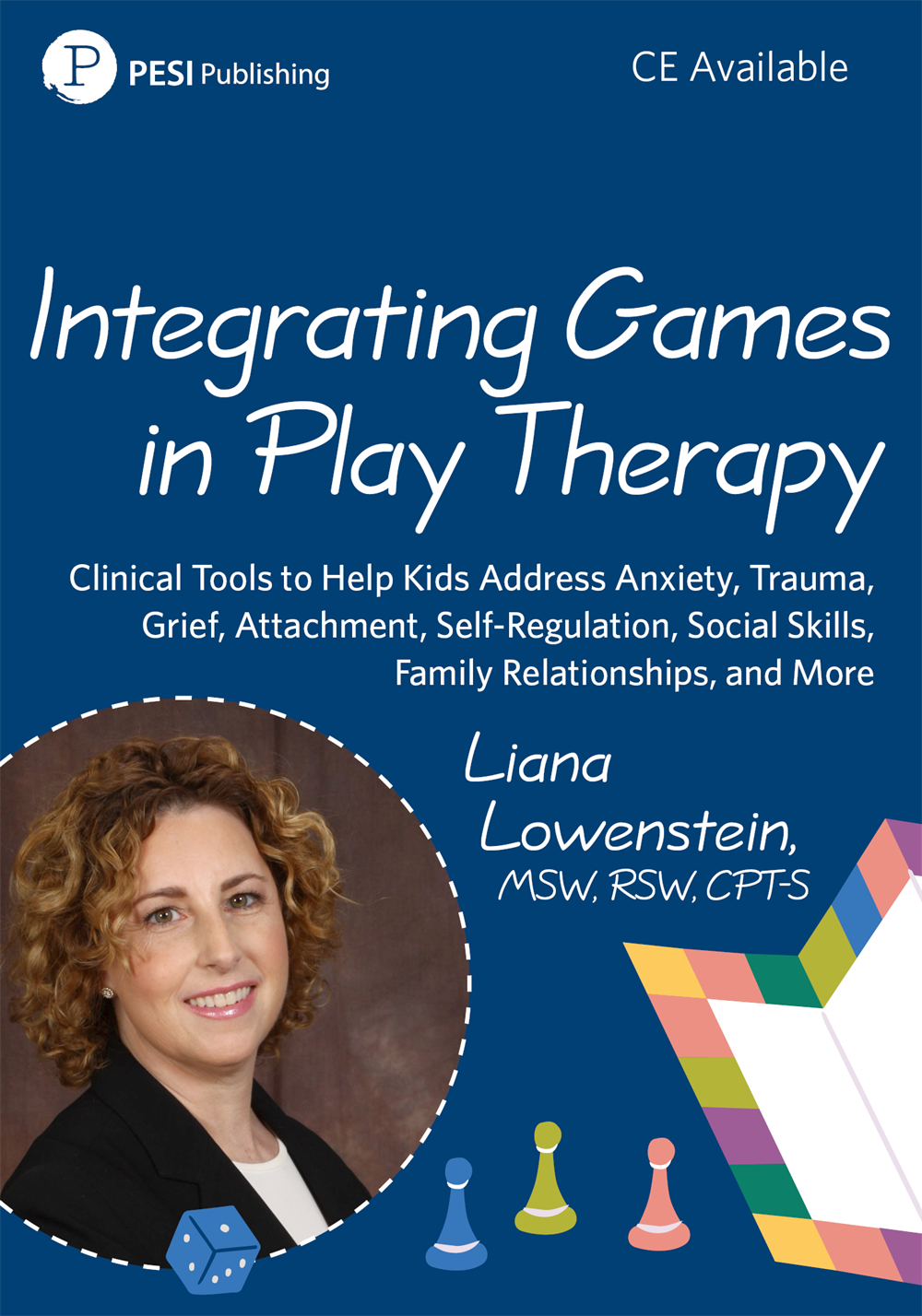
Integrating Games in Play Therapy: Clinical Tools to Help Kids Address Anxiety, Trauma, Grief, Attachment, Self-Regulation, Social Skills, Family Relationships, and More
- Speaker:
- Liana Lowenstein, MSW, RSW, CPT-S
- Duration:
- 5 Hours 52 Minutes
- Format:
- Audio and Video
- Copyright:
-
Oct 29, 2025
- Product Code:
- POS150502
- Media Type:
- Digital Seminar

Description
Games aren’t just fun – they’re powerful therapeutic tools!
This highly engaging workshop explores how to use games in play therapy as a medium for healing and growth in children, youth, and families in a way that is intentional and therapy goal-oriented.
Many children struggle to express themselves in traditional talk therapy, but through game-based play therapy, therapists can bypass resistance, build trust, and unlock emotional insight in a developmentally sensitive way.
In this practical and hands-on training, participants will:
- Explore the theoretical foundations of using games in play therapy.
- Discover criteria for selecting or adapting games to meet play therapy treatment goals.
- Learn how to use therapeutic responses and debriefing strategies to maximize clinical impact.
- Walk away with a ready-to-use toolbox of original therapeutic games to address a wide range of presenting issues in a play therapy session.
From games that build rapport and foster emotional expression to activities that target self-regulation, social skills, self-esteem, and family connection, this workshop offers a dynamic and creative approach to therapy.
Whether you're just starting out or are a seasoned play therapist, you'll gain a fresh toolbox of engaging, ready-to-use games to help children and families address a wide range of issues.
Credit
Speaker

Liana Lowenstein, MSW, RSW, CPT-S Related seminars and products
Liana Lowenstein is a licensed clinical social worker, certified play therapist-supervisor, and certified TF-CBT therapist who has been working with children and their families in Toronto for over 35 years. Her areas of specialty include treating trauma, bereavement, divorce, anxiety, and ADHD. She integrates play therapy into evidence-based models such as CBT and TF-CBT. In addition to her clinical practice, she provides supervision and consultation to mental health professionals. Liana’s 14 books are used by mental health professionals and children’s support workers all over the world, and several have been translated into Chinese, Korean, and Turkish. Her best-selling titles include Creative Interventions for Bereaved, Creative Interventions for Children of Divorce, Creative CBT Interventions for Children with Anxiety, and Cory Helps Kids Cope with Sexual Abuse. Her latest book, Cory Helps Kids Cope with Grief: Playful Activities for Young Children, helps young grievers impacted by suicide, homicide, drug overdose, natural disasters, mass violence, war, military casualties, and other types of loss.
Liana is a frequent keynote speaker at international conferences and agency training events, and has provided workshops throughout North America and abroad, including China, South Africa, Israel, England, New Zealand, Australia, and Slovenia. Liana has trained mental health professionals and grief group facilitators on innovative ways of supporting bereaved children, including presentations at the ADEC through the Learning Institute at the Sick Kids Centre for Community Mental Health.
Speaker Disclosures:
Financial: Liana Lowenstein maintains a private practice and receives compensation as a consultant. She receives royalties as a published author. Liana Lowenstein receives a speaking honorarium, book, and recording royalties from PESI, Inc. She has no relevant financial relationships with ineligible organizations.
Non-financial: Liana Lowenstein is a member of the Ontario Association of Social Workers, the Ontario College of Social Workers and Social Service Workers, the Canadian Association for Child and Play Therapy, and the Association for Play Therapy.
Additional Info
Access for Self-Study (Non-Interactive)Access never expires for this product.
For a more detailed outline that includes times or durations of time, if needed, please contact cepepesi.com
Questions?
Visit our FAQ page at www.pesi.com/faq or contact us at www.pesi.com/info
Objectives
- Determine five therapeutic benefits of using games in play therapy.
- Appraise whether a game is appropriate for play therapy use with a client based on clinical, developmental, and cultural factors.
- Examine the process of presenting play therapy games and debriefing with clients afterward.
- Integrate “Points of Departure” while utilizing therapeutic game play in sessions with clients.
- Identify five facilitative responses that can be used during therapeutic game play to enhance engagement, skill-building, and processing.
- Choose five games for play therapy sessions with children, youth, and families.
Outline
Game Therapy: What it Is, Why it Works, and Who it’s For
- Working definition of game-based play therapy; scope
- When and why to use structured games in clinical practice
- Therapeutic benefits of using games in play therapy
- Limitations of the research and potential risks
Getting Started with Games in Play Therapy: Considerations for Game Selection, Client Fit, and Therapeutic Setup
- Game types (board games, cards, imaginative)
- Adapting commercial games for therapeutic use in play therapy
- Age, developmental, cultural, neurodiversity considerations
- Game selection based on presenting problem, stage of play therapy, client goals
Clinical Skills: Game-Based Assessment, Skill-Building, and Processing
- How to present the game to your play therapy client
- Using gameplay therapeutically to explore relational dynamics, core beliefs, skills, and self-concept
- Recognizing therapeutic “points of departure” in play therapy sessions
- Techniques for steering game play toward meaningful insight and reflection
- Therapeutic responses that validate, reframe, or deepen a child’s experience
- Strategies for managing dysregulation, cheating, or competition during gameplay
- Transitioning from play to processing when the game has ended
Game-Based Play Therapy in Action: Case Studies and Activity Demonstrations
- Rapport building: Reduce anxiety, build positive therapeutic rapport
- Feelings expression: label, identify, and safely express a range of emotions, and explore emotional intensity, body cues, and triggers
- Focus and self-regulation: target attention, impulse control, emotional modulation, and active regulation
- Social skills: promote cooperation, communication, perspective-taking, conflict resolution, listening, and empathy
- Anxiety and fears: provide psychoeducation and strategies for managing anxiety
- Trauma and stress: Normalize common responses to trauma, address cognitive distortions
- Self-Esteem: identify strengths and build positive self-concept and resilience, as well as identity exploration
- Family interaction: attachment, communication, and problem-solving within families
- Termination: Affirm therapeutic progress and provide a positive ending to play therapy
Target Audience
- Licensed Clinical/Mental Health Counselors
- Marriage & Family Therapists
- Psychologists
- Social Workers
- Play Therapists
- Child Therapists



Reviews
Satisfaction Guarantee
Your satisfaction is our goal and our guarantee. Concerns should be addressed to: PO Box 1000, Eau Claire, WI 54702-1000 or call 1-800-844-8260.
ADA Needs
We would be happy to accommodate your ADA needs; please call our Customer Service Department for more information at 1-800-844-8260.
PESI Mobile App
Access CE trainings on your phone or tablet through our free mobile app. Choose video or audio-only versions of online courses from the world’s best instructors, and complete your CE requirements anywhere, anytime, at your own pace.




Please wait ...