
Digital Version Available
Get immediate lifetime access to this content by purchasing the digital seminar/online course instead that you can access using a variety of devices, and one CE certificate is included with purchase! Click the “Digital Seminar” or "Online Course" link below to learn more!
DVD Purchasers please note: In order to view the content, you will be required to have a DVD player or a DVD drive on your computer. Your CE is a separate fee.
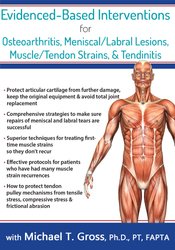
Evidence-Based Interventions for Osteoarthritis, Meniscal/Labral Lesions, Muscle/Tendon Strains, & Tendinitis
- Speaker:
- Michael T. Gross, PhD, PT, FAPTA
- Duration:
- Full Day
- Copyright:
-
Jun 21, 2017
- Publisher:
- PESI Publishing
- Product Code:
- RNV063345
- Media Type:
- DVD

Description
- Protect articular cartilage from further damage, keep the original equipment & avoid total joint replacement
- Comprehensive strategies to make sure repairs of meniscal and labral tears are successful
- Superior techniques for treating first-time muscle strains so they don’t recur
- Effective protocols for patients who have had many muscle strain recurrences
- How to protect tendon pulley mechanisms from tensile stress, compressive stress & frictional abrasion
The content of this course will help clinicians with clinical decision-making to take your practice to an advanced level. Discussion topics are based on research that Dr. Gross has synthesized over the past 30 years of practice, research and teaching. You will leave able to determine the scientific basis to change practice patterns immediately as you return to patient care.
If you could confidently answer the questions below, imagine how it could impact your practice…
- What hand should be used for cane use if a patient has knee varus versus knee valgus?
- What are the appropriate clinical interventions for tendinopathies in instances where tendons wrap around tendon pulley mechanisms?
- What happens when excessive pressures are transmitted across epiphyseal plates?
- How do we help young patients prevent avulsion fractures of apophyses?
- How do we help our patients prevent muscle strain recurrences?
- What are the best detection methods for labral lesions at the hip or glenohumeral joints?
- What are the best detection methods for meniscus lesions at the knee?
- What are evidenced-based guidelines for interventions of knee meniscus lesions, as well as labral lesions of the hip or shoulder?
Credit
Speaker
Michael T. Gross, PhD, PT, FAPTA Related seminars and products
Michael T. Gross, PhD, PT, FAPTA, has 37 years of experience as a licensed physical therapist, specializing in the areas of biomechanics and orthopaedic assessment and treatment. He has maintained a consistent clinical practice for all of these years, currently seeing patients 2 days per week at his faculty practice.
He is a professor in the PhD Program in Human Movement Science, and the Doctorate of Physical Therapy (DPT) program in the Division of Physical Therapy at the University of North Carolina at Chapel Hill. Dr. Gross has 70 refereed journal publications in such journals as the Journal of Orthopaedic and Sports Physical Therapy, Physical Therapy, and the Journal of Manual and Manipulative Therapy. He was an Editorial Review Board Member for the Journal of Orthopaedic and Sports Physical Therapy and serves as a reviewer for many other journals. Dr. Gross was awarded the Teaching Excellence Award from the University of North Carolina at Chapel Hill School of Medicine and the Margaret L. Moore Award for Outstanding New Academic Faculty by the American Physical Therapy Association.
He also was elected as a Fellow of the American Physical Therapy Association. He has given well over 300 regional, national, and international presentations, which have been highly rated by attendees for knowledge, skill, and humor.
Speaker Disclosures:
Financial: Michael Gross is a Professor, Division of Physical Therapy, at the University of North Carolina - Chapel Hill. He receives a speaking honorarium from PESI, Inc.
Nonfinancial: Michael Gross has no relevant nonfinancial relationship to disclose.
Additional Info
Access for Self-Study (Non-Interactive)Access never expires for this product.
Questions?
Visit our FAQ page at www.pesi.com/faq or contact us at www.pesi.com/info
Outline
OSTEOARTHRITIS
- Composition of articular cartilage
- Mechanical properties of articular cartilage
- The 3 main destroyers of articular cartilage
- Exercise parameters that protect articular cartilage from frictional abrasion
- Protecting your patient from impact loading
- Strategies to alter contact pressures
- Conservative and invasive repair attempts and how to manage them
- The interplay between running shoes and foot strike pattern
- So, you thought you knew what hand to use with a cane for knee varus/valgus?
MENISCAL/LABRAL LESIONS
- Changing your thinking about post-scope meniscectomy
- Improving meniscus repair response
- Detecting SLAP lesions – what will be the patient’s story?
- Detecting SLAP lesions – the best special tests
- Basics of SLAP lesion rehab based on lesion type/repair of the lesion
- Detecting hip labral lesions
- Rehabilitation of hip labral lesions
- Joint instability models and effect on meniscus
- Improving the repair response
- Meniscus transplantation
MUSCLE/TENDON STRAINS
- Why the weekend warrior is prone to muscle-tendon juncture injuries - at the microscopic level
- The Jarvinen Approach to treating muscle strain injuries
- Factors that explain why patients have
- recurrent muscle strains – how to end the vicious cycle
- Dealing with compartment injuries
- Apophyseal injuries in the young
- Avulsion injuries among older adults
TENDINITIS
- Tendon structure in healthy tendon and in tendon with chronic tendinosis
- Treating acute tendinitis versus chronic tendinosis
- Tendon pulley mechanisms – the triple whammy
- Strategies to decrease compressive stress in tendon pulley mechanisms
- Strategies to decrease frictional abrasion in tendon pulley mechanisms
- Application of tendon pulley mechanisms to the shoulder, wrist, and ankle
- The “Wringing Out Effect” of Rathbun and McNab and its applications
Objectives
- Plan strategies for protecting articular cartilage from further damage, keeping the original equipment, and avoiding total joint replacement.
- Analyze comprehensive strategies that ensure repairs of meniscal and labral tears are successful.
- Implement superior techniques for treating first-time muscle strains so they don’t recur.
- Evaluate treatment protocols for patients who already have had many muscle strain recurrences so that they have no additional recurrences.
- Select interventions to protect tendon pulley mechanisms from tensile stress, compressive stress, and frictional abrasion.
- Implement effective strategies for rehabilitating chronic tendinosis and acute tendinitis.
Target Audience
Athletic Trainers, Nurses, Occupational Therapists & Occupational Therapy Assistants, Physical Therapists/Physical Therapist Assistants, Physician Assistants, and other Healthcare Professionals.Reviews
Satisfaction Guarantee
Your satisfaction is our goal and our guarantee. Concerns should be addressed to: PO Box 1000, Eau Claire, WI 54702-1000 or call 1-800-844-8260.
ADA Needs
We would be happy to accommodate your ADA needs; please call our Customer Service Department for more information at 1-800-844-8260.
PESI Mobile App
Access CE trainings on your phone or tablet through our free mobile app. Choose video or audio-only versions of online courses from the world’s best instructors, and complete your CE requirements anywhere, anytime, at your own pace.




Please wait ...