
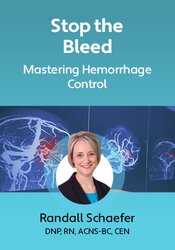
Hemorrhage Control: Stop the Bleeding & Replace What is Lost
- Speaker:
- Randall Schaefer, DNP, RN, ACNS-BC, CEN
- Duration:
- 2 Hours 06 Minutes
- Format:
- Audio and Video
- Copyright:
-
Sep 25, 2024
- Product Code:
- POS078913
- Media Type:
- Digital Seminar

Description
Provides an in-depth exploration of life-saving techniques and strategies for managing severe bleeding. Participants will examine the scope of hemorrhage-related deaths, the latest shifts in trauma care priorities, and effective methods for replacing lost blood, including the use of low-titer O positive whole blood.
Credit
Speaker
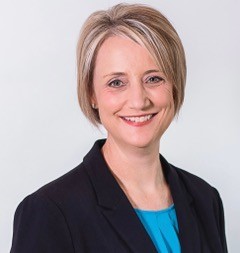
Randall Schaefer, DNP, RN, ACNS-BC, CEN Related seminars and products
Randall M. Schaefer, DNP, RN, ACNS-BC, CEN, (Lieutenant Colonel, US Army, Retired) served 20 years as an Emergency/Trauma Nurse, including three deployments supporting Operations Iraqi Freedom and Inherent Resolve. She played a key role in establishing Walking Blood Banks and implemented emergency blood storage policies that reduced transfusion times at Ft. Hood. After retiring in 2017, Dr. Schaefer directed the Southwest Texas Regional Advisory Council’s Combat Casualty Care Research Program, where she developed the country’s first Regional Whole Blood Program. She has presented at major conferences and is a lead author on 10 publications regarding prehospital blood use.
Speaker Disclosures
Financial: Randall Schaefer has an employment relationship with Schaefer Consulting, LLC. She is a consultant with 410 Medical, QinFlow, Delta Development, and TACMED Solutions. She receives a speaking honorarium and recording royalties from PESI, Inc. All relevant financial relationships with ineligible organizations have been mitigated.
Non-financial: Randall Schaefer has no relevant non-financial relationships.
Additional Info
Access for Self-Study (Non-Interactive)Access never expires for this product.
Objectives
- Identify the impact of trauma and prehospital hemorrhage in the United States.
- Identify 4 ways to achieve hemorrhage control.
- Describe how massive blood transfusion is a predictor of injury mortality.
- Describe how prehospital and hospital training & transfusion protocols have been written and implemented.
- Discuss the benefits of a systematic approach.
- Discuss data collection methods for prehospital and hospital process improvement and research efforts.
Outline
Scope of The Problem/Background
- Prevalence of hemorrhage in trauma deaths
- Mortality statistics in civilian/combat settings
- Bleeding mechanisms
- Challenges in intervention
Why & Where Trauma is Killing People
- Prehospital deaths: urban/rural differences
- Golden hour: impact of delays
Rethinking A-B-C
- Shift to C-A-B: hemorrhage control first
- Priority change: circulation over airway
Replacing What is Lost
- Crystalloids vs blood products
- Best fluids for trauma resuscitation
History of Low-Titer O Positive Whole Blood
- Origins and use in trauma
- Whole blood vs component therapy
Prehospital Blood Program Implementation
- Logistics and storage challenges
- Successful implementations
Regional Trauma System Case Study
- Adoption of whole blood in trauma systems
- Outcome improvements with whole blood
Key Takeaways
- Rapid hemorrhage control critical for survival
- Future innovations in hemorrhage control
Target Audience
- Nurses
- NPs
- PA
- Physicians
- EMS
Reviews
Satisfaction Guarantee
Your satisfaction is our goal and our guarantee. Concerns should be addressed to: PO Box 1000, Eau Claire, WI 54702-1000 or call 1-800-844-8260.
ADA Needs
We would be happy to accommodate your ADA needs; please call our Customer Service Department for more information at 1-800-844-8260.
PESI Mobile App
Access CE trainings on your phone or tablet through our free mobile app. Choose video or audio-only versions of online courses from the world’s best instructors, and complete your CE requirements anywhere, anytime, at your own pace.




Please wait ...