
Digital Version Available
Get immediate lifetime access to this content by purchasing the digital seminar/online course instead that you can access using a variety of devices, and one CE certificate is included with purchase! Click the “Digital Seminar” or "Online Course" link below to learn more!
DVD Purchasers please note: In order to view the content, you will be required to have a DVD player or a DVD drive on your computer. Your CE is a separate fee.
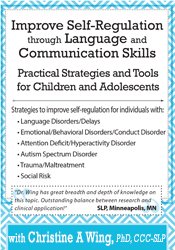
Improve Self-Regulation Through Language & Communication Skills: Practical Strategies & Tools for Children & Adolescents
- Speaker:
- Christine A Wing, PhD, CCC-SLP
- Duration:
- Full Day
- Copyright:
-
Sep 30, 2016
- Publisher:
- PESI Inc.
- Product Code:
- RNV062205
- Media Type:
- DVD

Description
You’ve worked with the child who has difficulty transitioning from one activity to another, becoming upset or overly silly. Waiting for his turn is difficult if not impossible, as is following daily routines. Despite repeated requests from his teacher to “use your words,” he typically is not able to communicate his wants and needs and becomes angry or shuts down. This child lacks self-regulation, and struggles both academically and socially.
Communication skills play an important role in the development of self-regulation. In this workshop, you will learn how to use language to improve self-regulation for children with:
- Language delays/disorders
- Emotional & Behavior Disorders
- Attention deficit/hyperactivity disorder
- Attachment disorders
- Autism
- Social Risk
You will learn techniques in formats that you can apply to your work immediately, illustrated through case studies and intervention videos. Bring your challenges with you to the workshop, as Dr. Wing will also facilitate group problem-solving. Discover new and innovative ways to help children develop self-regulation through language!
Credit
Speaker

Christine A Wing, PhD, CCC-SLP Related seminars and products
Christine A. Wing, PhD, CCC-SLP, has worked extensively with children at risk for or demonstrating significant behavior problems. She has worked closely with educators, mental health professionals, and therapists in both educational and health care settings. Dr. Wing integrates her clinical work as a certified speech and language pathologist with her own research on the relationships between language and behavior problems.
Dr. Wing has served on the board of directors and as the chairperson of the Minnesota Association for Infant and Early Childhood Mental Health. She is an advocate for children and families, and in addition to a Ph.D. in the area of language development, holds a master’s degree in public policy. Dr. Wing has presented at state associations for speech and language professionals and childcare providers as well as educators. She has also presented at the American Speech and Hearing Association, the American Association of University Women, and the International Society for the Study of Behavior Development. Dr. Wing currently provides consultation to organizations providing services to children and families.
Speaker Disclosures:
Financial: Dr. Christine Wing has an employment relationship with Strategic Solutions, Inc. She has presented at numerous state and national conferences. She receives a speaking honorarium from PESI, Inc. Christine has no relevant financial relationships with ineligible organizations.
Non-financial: Dr. Christine Wing has no relevant non-financial relationship to disclose.
Additional Info
Access for Self-Study (Non-Interactive)Access never expires for this product.
Questions?
Visit our FAQ page at www.pesi.com/faq or contact us at www.pesi.com/info
Target Audience
Counselors, Teachers/Educators, Occupational Therapists & Occupational Therapy Assistants, Physical Therapists/Physical Therapist Assistants, Psychologists, Social Workers, Speech-Language Pathologists, and other Mental Health ProfessionalsObjectives
- Characterize the roles of language comprehension, expression, and pragmatics in the development of self-regulation.
- Articulate the role of internal state words in the development of self-regulation.
- Analyze shared competencies for the multidisciplinary team providing service to children.
- Articulate the key elements of reflective practice in the therapeutic setting.
- Evaluate appropriate strategies (based on the service setting) to increase self-regulation
- Develop appropriate interventions that can readily become part of the program currently being used for children at participant’s service setting.
Outline
Relationship Between Language and Behavior- Language comprehension and expression
- Language pragmatics
- Dynamics of shared risk factors:
- depression, family conflict, parent education, fathers, and attachment
- Internal state words/words that express:
- Volition/ability Physical states
- Perception Emotions
- Morality Thought
- Working at the intersection of socialemotional and language development
- Facilitate self-regulatory language
- Theory of Mind
- Executive Function
- Determine knowledge and use of internal state words
- Fast mapping internal state words for early language
- Words for:
- Intention Ability
- Judgment Cognition
- Time
- Condition build problem-solving
- Self-talk for problem-solving video
- Screen for language reception, expression, and pragmatics
- Identify behavior problem and use corresponding verbal input
- Debrief after problem episode
- Script development demonstration and video examples
- Use role models
- Co-regulation strategies
- Nonverbal body-calming techniques
- Focus and condense instructions
- Language for organization and staying on task
- Determine child’s level of language skills
- Cues for low to high language levels
- Transition to self-cuing
- Translate behavior to words
- Pair sensory experiences with words for physical states and perception
- Recognize and represent emotions
- Apps for storytelling
- Personal narratives for high functioning ASD
- Apply attachment theory to daily conversationsv
- Relationship-based language
- Personal narratives
- Language to decrease disassociation and hyper-vigilance
- Internal state words to build awareness of child and self
- Case study
- Increase language interactions in small groups
- Use social-emotional themes: lesson plans
- Internal State Language Intervention
- Program (ISLIP) handout
- Video demonstration of ISLIP lesson plan
Reviews
| 5 |
|
| 4 |
|
| 3 |
|
| 2 |
|
| 1 |
|
Overall: 4.7
Total Reviews: 11
Satisfaction Guarantee
Your satisfaction is our goal and our guarantee. Concerns should be addressed to: PO Box 1000, Eau Claire, WI 54702-1000 or call 1-800-844-8260.
ADA Needs
We would be happy to accommodate your ADA needs; please call our Customer Service Department for more information at 1-800-844-8260.
PESI Mobile App
Access CE trainings on your phone or tablet through our free mobile app. Choose video or audio-only versions of online courses from the world’s best instructors, and complete your CE requirements anywhere, anytime, at your own pace.




Please wait ...