
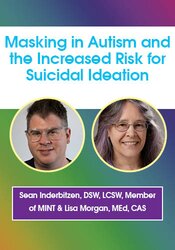
Masking in Autism and the Increased Risk for Suicidal Ideation
Internal Family Systems & Strength-Based Models for Identification, Safety Planning, and Treatment
- Speakers:
- Sean Inderbitzen, DSW, LCSW | Lisa Morgan, MEd, CAS
- Duration:
- 1 Hour 30 Minutes
- Format:
- Audio and Video
- Copyright:
-
Apr 21, 2023
- Product Code:
- POS059383
- Media Type:
- Digital Seminar

Description
Autistic individuals learn to mask their traits as a way of fitting in and navigating a world that is not designed for them. This social survival strategy – to stay emotionally and social safe from rejection, bullying, and ostracization – comes at a cost.
Masking is overwhelming. It is exhausting. And often leads to increased rates of anxiety, depression, and suicidal ideation.
As clinicians, we need to be aware of the potential for masking and be prepared to support our clients in identifying and understanding this phenomenon.
Join two autistic clinicians Sean Inderbitzen, LCSW, MINT and Lisa Morgan, M.Ed, CAS, for this fireside chat to learn how to identify when masking is present in autistic adults, in what context masking is helpful, and begin the challenging process of unmasking in two safe and neurodiversity-affirming ways!
Lisa guides you through a strengths-based approach to:
- Begin the process for safety planning and stabilization
- Help clients begin to unmask and understand who they are
- Promote a sense of agency and control in their lives reducing suicidal ideation
Sean unpacks an Internal Family Systems (IFS) approach to help autistic clients:
- Process how masking is adaptive and when it becomes maladaptive
- Understand how vulnerable, firefighter and manager parts impact masking
- Manage anxiety and improve mood, self-esteem, and interpersonal communication
This product is not endorsed by, sponsored by, or affiliated with the IFS Institute and does not qualify for IFS Institute credits or certification.
Credit
Handouts/Brochure
| File type | File name | Number of pages | |
|---|---|---|---|
| Manual - Masking Autism and the Increased Risk for Suicidal Ideation (3.2 MB) | 42 Pages | Available after Purchase | |
| Transcript - Masking in Autism and the Increased Risk for Suicidal Ideation (113.9 KB) | 21 Pages | Available after Purchase | |
| Illinois Educators Self-Study Instructions (15.4 KB) | Available after Purchase | ||
| Illinois Educators Evaluation Form (1.2 MB) | Available after Purchase | ||
| Instructions for ASHA credit - Self-Study Only (64.4 KB) | Available after Purchase |
Speaker

Sean Inderbitzen, DSW, LCSW Related seminars and products
DBA Inderbitzen Consulting Services LLC
Sean Inderbitzen, DSW, LCSW, an autistic psychotherapist and researcher through Mayo Clinic Health System. He regularly trains healthcare professionals to be more confident when working with people on the spectrum. He is coauthor, along with Stephen Porges, of Autism in Polyvagal Terms: New Possibilities and Interventions, part of W.W. Norton’s Interpersonal Neurobiology Series.
Financial: Sean Inderbitzen has employment relationships with Northlakes Community Clinic and Inderbitzen Consulting Services, LLC. He receives royalties as a published author. He receives a speaking honorarium and recording royalties from PESI, Inc. He has no relevant financial relationships with ineligible organizations.
Non-financial: Sean Inderbitzen has a professional relationship with Dr. Stephen Porges, Barry Prizant, and Pat Ogden.

Lisa Morgan, MEd, CAS Related seminars and products
Lisa Morgan, MEd, CAS, is a consultant specializing in crisis support and suicide prevention for autistic people. Lisa is founder and co-chair of the Autism and Suicide committee at the American Association of Suicidology (AAS) and has developed several autism specific resources for communicating and supporting autistic people in crisis. A self-advocate with a passion for strengths-based solutions, Lisa has authored several books, articles, and resources all available on her website, www.autismcrisissupport.com. She is a community council member of AASET (Autistic Adults and other Stakeholders Engaged Together), a group of autistic adults informing autism research priorities. Lisa has a master’s degree in the Art of Teaching. She is a certified autism specialist, a peer reviewer of the online journal, Autism in Adulthood, and owner of Lisa Morgan Consulting, LLC.
Speaker Disclosures:
Financial: Lisa Morgan has an employment relationship with Lisa Morgan Consulting, LLC. She is a consultant with NIMH and AASET-MHTP. Lisa Morgan receives royalties as a published author. She receives a speaking honorarium and recording royalties from PESI, Inc. She has no relevant financial relationships with ineligible organizations.
Non-financial: Lisa Morgan is the founder and co-chair of the Autism and Suicide Prevention Workgroup.
Additional Info
Questions?Visit our FAQ page at www.pesi.com/faq or contact us at www.pesi.com/info
Access for Self-Study (Non-Interactive)
Access never expires for this product.
For a more detailed outline that includes times or durations of time, if needed, please contact cepesi@pesi.com. ** no”Access to Self Study” tab available.
Objectives
- Identify when masking is present in autistic adults and understand the increased risk for suicidal ideation.
- Evaluate the difference between a strengths-based approach and internal family systems approach to unmasking and when to use each.
- Use a strengths-based approach to identify when masking is present and begin the process of safety planning and stabilization.
- Apply an IFS approach to help autistic clients process how their masking has been adaptive and maladaptive over their life.
Outline
Masking in Autistic Adults- How masking becomes adaptive
- Is masking always maladaptive – The Debate
- Risk for increased suicidal ideation
- Strengths-based approach to:
- Hone observational skills to identify masking
- Begin the process of safety planning and stabilization
- Promote a sense of agency and control reducing suicidal ideation
- IFS treatment to help clients
- Process how masking is maladaptive and when it becomes maladaptive
- Understand how vulnerable, firefighter and manager parts impact masking
- Manage anxiety and improve mood, self-esteem, and interpersonal communication
Target Audience
- Licensed Clinical/Mental Health Counselors
- Marriage and Family Therapists
- Nurses
- Nursing Home/Assisted Living Administrators
- Occupational Therapists
- Occupational Therapy Assistants
- Psychologists
- School Administrators
- Social Workers
- Speech-Language Pathologists
- Teachers/School-Based Personnel
Reviews
Satisfaction Guarantee
Your satisfaction is our goal and our guarantee. Concerns should be addressed to: PO Box 1000, Eau Claire, WI 54702-1000 or call 1-800-844-8260.
ADA Needs
We would be happy to accommodate your ADA needs; please call our Customer Service Department for more information at 1-800-844-8260.
PESI Mobile App
Access CE trainings on your phone or tablet through our free mobile app. Choose video or audio-only versions of online courses from the world’s best instructors, and complete your CE requirements anywhere, anytime, at your own pace.




Please wait ...