
Digital Version Available
Get immediate lifetime access to this content by purchasing the digital seminar/online course instead that you can access using a variety of devices, and one CE certificate is included with purchase! Click the “Digital Seminar” or "Online Course" link below to learn more!
DVD Purchasers please note: In order to view the content, you will be required to have a DVD player or a DVD drive on your computer. Your CE is a separate fee.
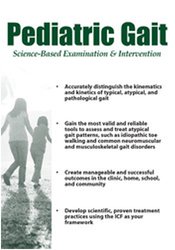
Pediatric Gait: Science-Based Examination and Intervention
- Speaker:
- Paula J Cox, PT, DSc, PCS
- Duration:
- 5 Hours 22 Minutes
- Copyright:
-
Nov 20, 2014
- Publisher:
- PESI Inc.
- Product Code:
- RNV020131
- Media Type:
- DVD

Description
Interventions with Pediatric Gait: What Works & What Doesn't
For those who assist pediatric patients with gait, you know firsthand the crucial role that autonomous locomotion has on the lives of infants and children, especially in regards to participating with their peers. However, are you utilizing scientific practices in the examination, evaluation, and treatment of the children with whom you work? Are you using the latest and most appropriate interventions for pediatric gait disorders based on the evidence?
Find out how you can improve your care with children's gait in this recording. Skillfully explore the science of pediatric rehabilitation through the presentation of the ICF as a framework for pediatric physical therapy practice. Watch and learn as the group discusses the components of typical, atypical, and pathological gait. In addition, you will evaluate the most reliable and evidence-based tools to examine and assess skill levels and progress for children with commonly seen gait disorders. Return to your practice with the proper tools to move from an intuitive-based practice to a science-based practice, resulting in better outcomes for your clients.
Credit
Speaker

Paula J Cox, PT, DSc, PCS Related seminars and products
Paula Cox, PT, DSc, PCS, is a board-certified pediatric PT with over 35 years of experience in pediatric rehabilitation. She is a member of the APTA, the APPT, and the IL PT Association. Dr. Cox served on the APPT’s NICU to EI transition work group. She is committee chair for the APPT course Advanced Clinical Practice in Pediatric Therapy, an ongoing APPT course that investigates current theories and EBP across pediatric settings. Dr Cox presents the EI segment for this course. She operates a private pediatric practice in the Chicago area and provided ongoing mentoring to PT’s in 2013 from the University of Oklahoma. Her doctoral research examined the use of a robotic scooter to provide early autonomous locomotion for infants with Down Syndrome.
Speaker Disclosures:
Financial: Paula Cox maintains a private practice and has an employment relationship with Midwestern University. She receives compensation as a consultant. She receives a speaking honorarium and recording royalties from PESI, Inc. She has no relevant financial relationships with ineligible organizations.
Non-financial: Paula Cox has no relevant non-financial relationships.
Additional Info
Access for Self-Study (Non-Interactive)Access never expires for this product.
Questions?
Visit our FAQ page at www.pesi.com/faq or contact us at www.pesi.com/info
Objectives
- Identify valid and reliable measurement tools to use to evaluate gait disorders in pediatric practice
- Differentiate between evidence-based and non-evidence-based interventions
- Implement the ICF to assist in developing measurable and functional outcomes
- Develop plans to move practice into a scientific direction in consideration of neuroplasticity and motor learning
- Contrast atypical gait from pathological gait
- Review the International Classification of Function, Disability, and Health (ICF) and its use as a framework and guide in your practice
Outline
KINEMATICS & KINETICS OF TYPICAL, ATYPICAL, & PATHOLOGICAL GAIT
- Components of gait
- Alignment of joints during gait
- Force production and gait efficiency
INTERNATIONAL CLASSIFICATION OF FUNCTION, DISABILITY, & HEALTH (ICF)
- Review components of ICF
- ICF as a framework for pediatric practice
- Moving toward scientific practices
MEASUREMENT TOOLS
- Psychometrically sound measurement tools
- Valid and reliable measurement tools to assess gai
OUTCOME DEVELOPMENT
- Using ICF to inform outcome development
- Developing functional and measurable outcome
INTERVENTION
- What is evidence-based practice
- Review presently used interventions for neuromuscular and musculoskeletal gait disorders
- Neuroplasticity and motor learning, and their importance in intervention
- Research that supports or refutes effectiveness of interventions for common pediatric gait disorders
- Interventions for musculoskeletal and neuromuscular gait disorders with clear supportive evidence
OUTCOME MEASUREMENT
- Review need for psychometrically sound measurement tools
- Review valid and reliable outcome measurement tools
CASE STUDY
- Assessment
- Intervention
- Outcome
Target Audience
- Physical Therapists
- Physical Therapist Assistants
- Occupational Therapists
- Occupational Therapy Assistants
- Educators
- Rehabilitation Nurses
- Pediatric Nurse Practitioners
- Home Health Personnel
Reviews
Satisfaction Guarantee
Your satisfaction is our goal and our guarantee. Concerns should be addressed to: PO Box 1000, Eau Claire, WI 54702-1000 or call 1-800-844-8260.
ADA Needs
We would be happy to accommodate your ADA needs; please call our Customer Service Department for more information at 1-800-844-8260.
PESI Mobile App
Access CE trainings on your phone or tablet through our free mobile app. Choose video or audio-only versions of online courses from the world’s best instructors, and complete your CE requirements anywhere, anytime, at your own pace.




Please wait ...