
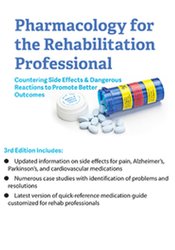
Pharmacology for the Rehabilitation Professional: Countering Side Effects & Dangerous Reactions to Promote Better Outcomes
- Speaker:
- Chad C. Hensel, PT, DPT, MHS, CSCS
- Duration:
- 5 Hours 58 Minutes
- Format:
- Audio and Video
- Copyright:
-
Mar 09, 2018
- Product Code:
- POS020337
- Media Type:
- Digital Seminar

Description
Many patients being referred to therapy are taking prescription and/or over-the-counter medications. Although many of these medications are directly related to their therapy diagnosis, some may not be. What should you know about clinical pharmacology to manage them effectively?
Watch leading rehab pharmacology expert, Dr. Suzanne Tinsley, as she examines the critical aspects of pharmacology, including the principles of pharmacodynamics and pharmacokinetics as well as how to apply these concepts to all drug classifications. You will hear specific concepts of the pharmacology of the central nervous system and autonomic nervous system.
You will analyze effects of drug actions on the major body systems, including mechanisms of therapeutic actions and adverse drug effects, problems involving drug interactions, and variables that modify drugs' effects. Special consideration will be given to many of the drugs most commonly used in treating cardiovascular and neuro-musculoskeletal disorders. Using case reports, you will uncover specific effects that have an impact on the rehabilitation management of patients and clients.
Credit
Speaker
Chad C. Hensel, PT, DPT, MHS, CSCS Related seminars and products
CHAD C. HENSEL, PT, DPT, MHS, CSCS, is a licensed, clinical physical therapist with over 20 years of experience in sports medicine, orthopedics, subacute care, neurological rehabilitation, and work hardening. Currently, he is the Director of the PTA Program at Marion Technical College. Dr. Hensel continues to work in the clinic at OhioHealth's Marion Medical campus where he is one of six lead Physical Therapists.
He has been on the faculty of the PTA programs at Sinclair Community College and Andrews University where he taught Intro to Pharmacology, Anatomy, and Therapeutic Exercise, pharmacotherapeutics, medical terminology and physiology, and developed pharmacology course content for the transitional doctorate program.
Dr. Hensel attended Bowling Green State University in consortium with the Medical College of Ohio for his undergraduate in Physical Therapy Education, and completed his Master of Health Science degree and Physical Therapy Doctorate from the University of Indianapolis.
Dr. Hensel is a Certified Strength and Conditioning Specialist through the National Strength and Conditioning Association and a Certified Weight Trainer with the International Weightlifting Association.
Speaker Disclosures:
Financial: Chad Hensel is the Director of the PTA Program at Marion Technical College. He receives a speaking honorarium from PESI, Inc.
Non-financial: Chad Hensel is a member of the American Physical Therapy Association; and the National Strength and Conditioning Association.
Additional Info
Access for Self-Study (Non-Interactive) Access never expires for this product.Questions?
Visit our FAQ page at www.pesi.com/faq or contact us at www.pesi.com/info
Objectives
- Describe the primary pharmacokinetic factors involved in drug administration, absorption, distribution, interaction, and elimination
- Explain how altered pharmacokinetics may lead to a decrease or an increase in drug effects, and how these effects may be recognized in patients receiving therapy
- Discuss the concepts of psychological and physical dependence, tolerance, withdrawal, receptor, sensitivity, and cross-tolerance
- Identify the general categories, mechanisms of action, risk-benefit ratio, and implications on interventions for the pharmacological agents routinely prescribed for conditions involving the cardiovascular, neuromuscular, endocrine, pulmonary, and central nervous systems
- Analyze the possible effects of various drug actions on the effectiveness of interventions and functional outcomes
- Determine the signs and symptoms of abuse
Outline
PRINCIPLES OF PHARMACOLOGY
- Pharmacokinetic principles
- Pharmacodynamics principles
- Their importance to rehabilitation
PHARMACOLOGY OF THE CENTRAL NERVOUS SYSTEM
- Common CNS drugs seen in rehabilitation
- Side effects and rehabilitation outcomes
PATIENT ORIENTED PROBLEM SOLVING (POPS) CASE STUDY
PAIN MANAGEMENT - NARCOTICS, NONSTERIODAL, ANTI-INFLAMMATORY DRUGS
- Advantages and disadvantages of each class
- Common side effects and their effect on rehabilitation outcomes
- Signs and symptoms of abuse
CARDIAC MEDICATIONS
- 5 classes of cardiac medications
- How these drugs are combined to treat cardiac disease/pathology
- Therapeutic effects and side effects that may interfere with rehabilitation outcomes
POPS CASE STUDIES
Target Audience
- Physical Therapists
- Physical Therapist Assistants
- Occupational Therapists
- Occupational Therapy Assistants
- Speech-Language Pathologists
- Nursing Home Administrators
- Athletic Trainers, Exercise Physiologists
- Nurses
- Respiratory Therapists
- Certified Strength and Conditioning Specialists
Reviews
Satisfaction Guarantee
Your satisfaction is our goal and our guarantee. Concerns should be addressed to: PO Box 1000, Eau Claire, WI 54702-1000 or call 1-800-844-8260.
ADA Needs
We would be happy to accommodate your ADA needs; please call our Customer Service Department for more information at 1-800-844-8260.
PESI Mobile App
Access CE trainings on your phone or tablet through our free mobile app. Choose video or audio-only versions of online courses from the world’s best instructors, and complete your CE requirements anywhere, anytime, at your own pace.




Please wait ...