
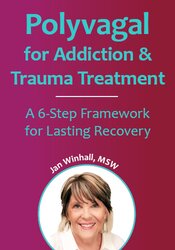
Polyvagal for Addiction & Trauma Treatment: A 6-Step Framework for Lasting Recovery
- Speaker:
- Jan Winhall, MSW PIFOT
- Duration:
- 6 Hours 53 Minutes
- Format:
- Audio and Video
- Copyright:
-
Dec 17, 2024
- Product Code:
- POS150154
- Media Type:
- Digital Seminar

Description
Addiction isn’t just about behaviors, it’s the nervous system’s call for survival.
As a clinician, you know it doesn’t come down to willpower or “bad” choices.
It’s trauma, chronic stress, and a nervous system stuck in overdrive…
…leaving clients trapped in survival states of fight, flight, or freeze – bringing therapy to a halt.
That’s where Polyvagal Theory comes in – it’s the missing link to helping clients break through these barriers by addressing what lies beneath.
In this training with Jan Winhall, celebrated psychotherapist, author and prominent Polyvagal Theory expert, you will learn to help facilitate clients finding safety, connection and co-regulation. Through case studies, demonstrations and insightful commentary you’ll takeaway concrete skills to:
- Find hidden pathways to safety and connection and put to rest ideas about “willpower”
- Promote recovery with tailored interventions to help clients shift from nervous system arousal to more regulated states
- Use “body cards” with clients to help pinpoint emotions trapped in the body and target the root causes of addiction and trauma
- Do meaningful assessments with the Embodied Assessment & Treatment Tool™ that sensitively explores attachment and trauma history
Plus, you’ll develop an integrated perspective on how harm reduction and polyvagal strategies can work together.
With the right tools, you can become the expert clients need to navigate recovery from both addiction and trauma.
Discover how harnessing Polyvagal Theory can transform addiction treatment and foster lasting recovery through connection.
Register now!
Credit
Speaker

Jan Winhall, MSW PIFOT Related seminars and products
Jan Winhall, MSW PIFOT is an author, teacher and seasoned trauma and addiction psychotherapist. She is an educational partner with the Polyvagal Institute where she offers a three-year training program based on her books Treating Trauma and Addiction with the Felt Sense Polyvagal Model and 20 Embodied Practices for Healing Trauma and Addiction: Using the Felt Sense Polyvagal Model, (Norton) 2025. She is an adjuct lecturer at the University of Toronto and a Certifying Co-Ordinator with the International Focusing Institute. Jan is co-director of the Borden Street Clinic where she supervises graduate students. She enjoys teaching all over the world. You can reach her at janwinhall.com.
Speaker Disclosures:
Financial: Jan Winhall maintains a private practice and has employment relationships with the University of Toronto, Athabasca University, Smith College, Yorkville University, and the Polyvagal Institute. She is the creator and co-director of Borden Street Clinic. Jan Winhall receives royalties as a published author. Jan Winhall receives a speaking honorarium from PESI, Inc. She has no relevant financial relationships with ineligible organizations.
Non-financial: Jan Winhall has no relevant non-financial relationships.
Additional Info
Questions?Visit our FAQ page at www.pesi.com/faq or contact us at www.pesi.com/info
Access for Self-Study (Non-Interactive)
Access never expires for this product.
Objectives
- Name the seven autonomic nervous system states in the Felt Sense Polyvagal Model.
- Describe the Trauma Feedback Loop.
- Describe the ‘plastic paradox' in Lewis learning model of addiction.
- Explain the Four Circle Harm Reduction Practice.
- Name the five lessons in polyvagal theory.
- Explain addiction from a polyvagal perspective.
- Describe the paradigm shift from a pathologizing lens to a strength based lens.
Outline
The Shift from Addiction Pathology to Strengths-Based Healing
- Pros and cons of DSM-TR-V™
- Limitations of the Brain Disease Model
- Addiction as ‘adaptive coping’ Inspiration from the early days of feminist therapy
- Connecting the interpersonal with neurobiology
The “Plastic Paradox” of Addiction
- Neuroplasticity and the changing brain
- Brain regions relevant to addiction treatment
- The “plastic paradox” of addiction
- A new lens: addiction as a neurophysiological survival state
Getting Started with Polyvagal Therapy
- 5 lessons of Polyvagal Theory
- Porges’ Polyvagal Model and updates to the traditional ANS model
- Honoring the mind-body connection through interoception
- Neuroception and the 7 F’s Graphic Model
- Simple language to use with clients
- Co-regulation is the “cure”
- Teaching interoception
- Skill building: Using body cards with “Blended States”
Polyvagal-Informed Six Steps of Focusing
- What is a Felt Sense? Integrating thoughts, feelings, memories and physical sensations
- Using The Experiencing Scale
- Guide to the structure of focusing dynamics in session
- Tuning into the Felt Shift: the motor of change
- Experiential practice with six steps of Focusing
The Intersection of Polyvagal, Trauma & Addiction
- “I’m a trauma therapist, I don’t work with addiction”
- The intimate connection between trauma and addiction
- Clients living in dorsal and sympathetic states
- “Triggers are our friends”
- The role of attachment styles in addiction history
- Experiential Exercise in Early Attachment Styles
- Dan Siegel’s interpersonal neurobiology & the 9 domains of integration
Treating Addiction with the Felt-Sense Polyvagal Model (FSPM)
- 5 foundational theories supporting the Felt-Sense Polyvagal Model
- 4 core FSPM concepts
- Skill Building:
- Neuroception: Teach clients to recognize and rewire nervous system states with 7 F’s
- Interoception: Create emotional regulation with the 6 Steps of Focusing
- Practice makes presence: The Felt Sense Ground Practice
- FSPM Harm Reduction Practice: 4 Circles Method
- Demonstration: FULL demonstration of the 4 Circle Harm Reduction Method
Target Audience
- Counselors
- Social Workers
- Psychiatrists
- Psychologists
- Case Managers
- Addiction Counselors
- Therapists
- Marriage & Family Therapists
- Psych Nurses
- Other Mental Health Professionals



Reviews
Satisfaction Guarantee
Your satisfaction is our goal and our guarantee. Concerns should be addressed to: PO Box 1000, Eau Claire, WI 54702-1000 or call 1-800-844-8260.
ADA Needs
We would be happy to accommodate your ADA needs; please call our Customer Service Department for more information at 1-800-844-8260.
PESI Mobile App
Access CE trainings on your phone or tablet through our free mobile app. Choose video or audio-only versions of online courses from the world’s best instructors, and complete your CE requirements anywhere, anytime, at your own pace.




Please wait ...