
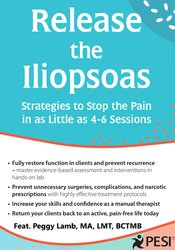
Release the Iliopsoas
Strategies to Stop the Pain in as Little as 4-6 Sessions
- Speaker:
- Peggy Lamb, MA, LMT, BCTMB
- Duration:
- Full Day
- Format:
- Audio and Video
- Copyright:
-
Nov 01, 2019
- Product Code:
- POS020136
- Media Type:
- Digital Seminar

Description
Your work with lower back pain can give clients their lives back, allowing them to once again enjoy the things that debilitating pain had taken from them.
But the iliopsoas, the biggest factor in low back or pelvis pain, can mimic numerous back and hip dysfunctions frustrating your ability to identify the root of your clients’ problem.
Not only that, but the iliopsoas is a difficult muscle to palpate, leaving you feeling hesitant and uncertain in your treatment plan. Ultimately, you can find yourself going down the wrong treatment path, feeling defeated and worried that your client will face surgery that you can have helped them avoid.
Feel your confidence grow and your skills sharpen as you gain new, evidence-based strategies to release the iliopsoas and stop the pain in as little as 4 to 6 sessions. Identify the root of the problem the first time by using special assessment tests and measures, so you can address the pain and restore function quicker.
Utilizing case studies and demonstration lab time, you'll finish this recording immediately ready to confidently tackle low back and pelvis pain in your clients.
Peggy Lamb, LMT, has spent the last 30 plus years as a manual therapist. In that time, she has treated numerous low back and pelvic dysfunctions by effectively releasing the iliopsoas, giving her clients a new lease on life.
Her experience and knowledge will allow you to also safely and gently release the fascial tissue so you can easily and confidently do the same for your clients.
Credit
Handouts/Brochure
| File type | File name | Number of pages | |
|---|---|---|---|
| Manual - Release the Iliopsoas (10.10 MB) | 67 Pages | Available after Purchase |
Speaker

Peggy Lamb, MA, LMT, BCTMB Related seminars and products
Peggy Lamb, MA, LMT, BCTMB, has been a manual therapist and bodyworker for over 30 years and is certified through the National Certification Board for Therapeutic Massage and Bodywork. She owns a private massage and movement therapy business, where she practices when she’s not lecturing. Ms. Lamb received her initial training at the New Mexico Academy of Massage and Advanced Healing Arts in Santa Fe, New Mexico, and at Wellness Skills, Inc., in Dallas, Texas. She taught clinical anatomy and physiology, trigger point therapy, and Swedish techniques at Wellness Skills, Inc., in Dallas and at Texas Healing Arts Institute in Austin. In addition to her extensive training massage therapy, she also teaches dance and yoga and is a personal trainer. She is the author of Releasing the Iliopsoas and Quadratus Lumborum and Stretch Your Patients: The Bodyworker’s Guide to Client Table Stretches. Ms. Lamb is an approved CE provider for the Texas Department of Health, the National Certification Board for Therapeutic Massage and Bodywork, and the Florida Department of Health. In addition, she has presented nationally at many AMTA state chapter conventions. Ms. Lamb brings her eclectic and extensive background into her teaching for an enlightening and enjoyable learning experience.
Speaker Disclosures:
Financial: Peggy Lamb maintains a private practice. She receives a speaking honorarium and consulting fees from PESI, Inc. Ms. Lamb is a published author and receives royalties. She has no relevant financial relationships with ineligible organizations.
Non-financial: Peggy Lamb has no relevant non-financial relationships.
Additional Info
Access for Self-Study (Non-Interactive)Access never expires for this product.
Questions?
Visit our FAQ page at www.pesi.com/faq or contact us at www.pesi.com/info
Objectives
- Review the anatomy of the low back and pelvis and what role the iliopsoas plays.
- Identify assessment tests for a short iliopsoas and rotated pelvis.
- Examine trigger point referral patterns of the iliopsoas.
- Practice techniques for palpating, stretching, and releasing the iliopsoas and secondary thigh flexors.
- Incorporate trigger point, myofascial, and deep tissue techniques to gently and effectively release the iliopsoas/secondary thigh flexors and ultimately save your hands.
- Discuss strategies for avoiding reoccurring injuries of the low back and pelvis.
Outline
THE ROLE OF THE ILIOPSOAS IN LOW BACK AND PELVIS HEALTH- Anatomy of the iliopsoas
- Role of the iliopsoas in joint centration
- Case and prevention of low back pain as related to the iliopsoas
- Importance of client education and safety
- Muscle Swimming – unique combination of several manual therapies
- Positional Release: a safe alternative to direct palpation
- Muscle Energy Techniques (MET
- Case Studies
- How to best test for short psoas
- How to best test for pelvic rotation
- Positional release for short psoas
- MET corrections for pelvic rotation
- Demo and Practice: examination for short psoas and pelvic rotations
- Identification of common trigger points in secondary thigh flexors
- Palpation of secondary thigh flexors
- Demo and Practice: techniques to release secondary thigh flexors
- Identification of common trigger points in the iliopsoas
- Palpation of the iliopsoas
- How to best “swim” through abdominal muscles
- Demo and Practice: techniques to release the iliopsoas
Target Audience
- Physical Therapists
- Physical Therapist Assistants
- Massage Therapists
- Occupational Therapists
- Certified Occupational Therapy Assistants
- Athletic Trainers
- Certified Strength and Conditioning Specialists
- Exercise Physiologists
- Personal Trainers
- Rehab Nurses
Reviews
Satisfaction Guarantee
Your satisfaction is our goal and our guarantee. Concerns should be addressed to: PO Box 1000, Eau Claire, WI 54702-1000 or call 1-800-844-8260.
ADA Needs
We would be happy to accommodate your ADA needs; please call our Customer Service Department for more information at 1-800-844-8260.
PESI Mobile App
Access CE trainings on your phone or tablet through our free mobile app. Choose video or audio-only versions of online courses from the world’s best instructors, and complete your CE requirements anywhere, anytime, at your own pace.




Please wait ...