
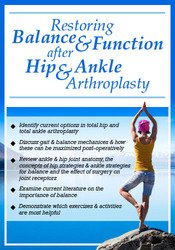
Restoring Balance & Function after Hip & Ankle Arthroplasty
- Speaker:
- Jason Handschumacher, PT, DPT, OCS
- Duration:
- 1 Hour 58 Minutes
- Format:
- Audio and Video
- Copyright:
-
Aug 03, 2017
- Product Code:
- POS020661
- Media Type:
- Digital Seminar

Description
How many times have you heard a patient say, “I had my hip replaced three years ago and it doesn’t hurt now. However, I just never got all my strength back and I still feel like I could lose my balance and fall”?
Following lower extremity total joint arthroplasty, it is common to focuses on pain reduction, basic trans-fers, range of motion and basic strengthening. Oftentimes this is where we or the patients stop. Long-term functional improvement and ambulation safety can be overlooked.
This course aims to emphasize the long-term outcomes following ankle and hip joint replacement. We will examine what current literature says about which post-operative deficits are most impactful and the best means of improving balance after the surgery. What works may be surprisingly simple.
Credit
Speaker
Jason Handschumacher, PT, DPT, OCS Related seminars and products
Jason Handschumacher, PT, DPT, OCS, is an expert in myofascial release, with over 16 years of clinical experience in some of the top facilities in the country. He practices at a hospital in the Charlotte metropolitan area, serving patients in acute, sub-acute, and outpatient settings. In addition, he sees patients at a clinic within an active adult community.
Dr. Handschumacher travels nationally to present seminars on myofascial release and is known for his dynamic, hands-on teaching style. He has presented research findings for state and national PT associations related to non-operative management of the rotator cuff, injury prevention, and the uses of therapeutic taping. Board Certified as an Orthopedic Clinical Specialist, Dr. Handschumacher earned his doctorate in physical therapy from Shenandoah University.
Speaker Disclosures:
Financial: Jason Handschumacher has an employment relationship with Springs Memorial Hospital. He receives a speaking honorarium from PESI, Inc.
Non-financial: Jason Handschumacher has no relevant non-financial relationship to disclose.
Additional Info
Access for Self-Study (Non-Interactive)Access never expires for this product.
Questions?
Visit our FAQ page at www.pesi.com/faq or contact us at www.pesi.com/info
Target Audience
Athletic Trainers, Occupational Therapy, Occupational Therapy Assistants, Physical Therapy, Physical Therapy AssistantsObjectives
- Identify current options in total hip & total ankle arthroplasty
- Discuss gait & balance mechanics & how these can be maximized post-operatively
- Review ankle & hip joint anatomy, the concepts of hip strategies & ankle strategies for balance & the effect of surgery on joint receptors
- Examine current literature on the importance of balance & proprioceptive training following each procedure
- Demonstrate which exercises & activities are most helpful, when to initiate each & which ones the patient should continue independently
Outline
Current options in total hip and total ankle arthroplasty- Review surgical techniques and components
- Common Dx leading to THA and TAA
- Post-operative timelines and when to initiate balance training with each population
- Review ankle and hip motions in “Normal” gait to understand which motions to emphasize
- Does the prosthesis limit range of motion and strength gain potential?
- Deficits at 6 months and 2 years post-operatively
- What is the role of proprioception and muscular response in balance and gait
- The role of neuroplasticity in balance recovery
- Role of symmetry training and impacts on the contralateral limb
- Why surgery seems to have greater impact on ankle joint receptors than in the hip
- Greater muscle mass in the hip and which muscles are the keys in balance
- Impact on patient perceived long-term outcome and how this can differ from the therapist
- Importance of patients regaining confidence and impact of fear of falling on actual falls
- How is the patient functioning long after discharge from formal therapy?
- Single limb stance and tandem stance activity early and late in rehabilitation
- Varying sensory inputs for progressions
- Effective strengthening exercises and proper dosing/overload principles
Reviews
Satisfaction Guarantee
Your satisfaction is our goal and our guarantee. Concerns should be addressed to: PO Box 1000, Eau Claire, WI 54702-1000 or call 1-800-844-8260.
ADA Needs
We would be happy to accommodate your ADA needs; please call our Customer Service Department for more information at 1-800-844-8260.
PESI Mobile App
Access CE trainings on your phone or tablet through our free mobile app. Choose video or audio-only versions of online courses from the world’s best instructors, and complete your CE requirements anywhere, anytime, at your own pace.




Please wait ...