
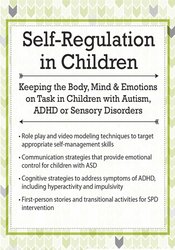
Self-Regulation in Children
Keeping the Body, Mind and Emotions on Task in Children with Autism, ADHD or Sensory Disorders
- Speaker:
- Gwen Wild, MOT, OTR/L
- Duration:
- 6 Hours 35 Minutes
- Format:
- Audio and Video
- Copyright:
-
Jan 31, 2020
- Product Code:
- POS063500
- Media Type:
- Digital Seminar

Description
Children with Sensory Processing Disorders, ADHD or autism have much in common. They are challenged with physical problems that affect their ability to focus and can also cause them to be emotionally reactive. Children who have trouble self-regulating throughout the day are missing out on typical childhood experiences in school, on the playground and with their families. They have difficulty making and keeping friends.
This recording looks at the underlying factors of poor self-regulation and how they affect the child. The course emphasizes practical interventions! You will walk away with strategies for creating simple but effective programs in clinical, school and home settings:
- Sensory therapy techniques
- Simple self-management and video modeling programs
- Sensory lifestyle programs
- First-person stories
- Energy regulation techniques
- Communication methods
- Transition strategies
- Behavioral strategies
Clinical programs such as Interactive Metronome® (IM), brushing, sensory diets, and MeMoves™ will be discussed, as will timely topics such as medication vs. non-medication for ADHD and new insights from research into biomedical aspects of autism.
Credit
Speaker

Gwen Wild, MOT, OTR/L Related seminars and products
Gwen Wild, MOT, OTR/L, is an occupational therapist with over 25 years of experience specializing in the treatment of children and adolescents diagnosed with Autism Spectrum Disorder, Sensory Processing Disorders, neurological disorders and a wide variety of developmental disorders in numerous settings. She is the owner of Sensational Brain, LLC, and creator of the popular BrainWorks™ tools, a system for creating effective sensory diets that empowers kids to take charge of their sensory needs.
Gwen is steadfast in helping children learn to self-regulate to manage their behaviors and emotions effectively. She works directly with educators, speech-language pathologists, occupational therapists, BCBAs and other professionals in her roles as an educator, consultant to two school districts and provider of private pediatric occupational therapy services in homes.
Gwen presents worldwide on topics related to sensory modulation and self-regulation teaching practitioners, parents, and teachers who work with children and adolescents practical treatments and interventions. She has been invited to speak at numerous state and local conferences and has been featured on podcasts. Gwen has led and co-authored two research studies on the implementation of sensory strategies for the purpose of enhancing self-regulation, the most recent of which was published in a peer-reviewed journal.
She is an active member of the American Occupational Therapy Association and at the state level, she is a member of the Michigan Occupational Therapy Association.
Speaker Disclosures:
Financial: Gwen Wild has employment relationships with Sensational Brain LLC, Calhoun ISD, and Summit Professional Education. She receives royalties as a published author. Gwen Wild receives a speaking honorarium and recording royalties from PESI, Inc. She has no relevant financial relationships with ineligible organizations.
Non-financial: Gwen Wild has no relevant non-financial relationships.
Additional Info
Access for Self-Study (Non-Interactive)Access never expires for this product.
Questions?
Visit our FAQ page at www.pesi.com/faq or contact us at www.pesi.com/info
Objectives
- Differentiate between symptoms of sensory modulation disorder, ADHD and autism to determine appropriate self-regulation interventions.
- Modify clinical treatments for Sensory Processing Disorder (SPD) to be utilized in school or home settings.
- Design a sensory lifestyle program using readily-found items to improve self-regulation skills in your young clients.
- Incorporate elements of first-person stories and transitional activities into your SPD intervention plan.
- Recommend cognitive strategies to address symptoms of ADHD, including hyperactivity and impulsivity.
- Implement role plays and video modeling interventions to target appropriate self-management skills.
Outline
How Self-Regulation Affects a Child’s Physical, Mental and Emotional Wellbeing- Overlay of systems
- Overlap with sensory processing disorder, ADHD, autism, giftedness, anxiety and related conditions
- Vestibular, proprioceptive, and sensory modulation characteristics
- What can go wrong
- Making it right: case studies and videos
- The big therapies: Interactive Metronome®, (IM), brushing, sensory diets, MeMoves™, and more!
- Strategies for over-responsivity, under-responsivity, cravings
- Develop sensory boxes, sensory schedules and spaces
- Bedtime tips and strategies
- Parker’s guidelines for giving meds
- Greenspan’s strategies for avoiding meds
- Cognitive strategies, attention strategies and mindfulness meditation
- As a powerful behavior program for ADHD
- Address challenging behaviors and habits through sensory-based activities
- Mindfulness and meditation techniques
- Role play and video modeling
- Teach functional skills
- Catch child “being good”
- Art and music activities for emotions
- Visual schedules
- Social stories
- Visual timers
- Layers of autism
- Working with emotions
- Communication strategies that provide control
- Match-and-repeat technique for social engagement
- Deal with picky eating and poor sleep habits
- Behavioral strategies for eliminating difficult behavior
- What, why and how
- Case studies of why we see certain behaviors
- Case study example reflecting successful intervention
- Strategies for smooth transitions
- Using objects to assist in transitions
- Environmental strategies
- Music, Me-Moves™
- Deep pressure
- Ease™
- Music therapy
- Alternative therapy
- Qi massage
Target Audience
- Occupational Therapists
- Occupational Therapy Assistants
- Educators
- Speech-Language Pathologists
- Counselors
- Psychologists
- Social Workers
- Marriage & Family Therapists
- Physical Therapists
- Physical Therapist Assistants



Reviews
| 5 |
|
| 4 |
|
| 3 |
|
| 2 |
|
| 1 |
|
Overall: 5
Total Reviews: 7
Satisfaction Guarantee
Your satisfaction is our goal and our guarantee. Concerns should be addressed to: PO Box 1000, Eau Claire, WI 54702-1000 or call 1-800-844-8260.
ADA Needs
We would be happy to accommodate your ADA needs; please call our Customer Service Department for more information at 1-800-844-8260.
PESI Mobile App
Access CE trainings on your phone or tablet through our free mobile app. Choose video or audio-only versions of online courses from the world’s best instructors, and complete your CE requirements anywhere, anytime, at your own pace.




Please wait ...