
Clinical Applications of the Polyvagal Theory with Stephen Porges, PhD, 7/15/2022 12:00:00 AM CDT, Digital Seminar More info »
Clinical Applications of the Polyvagal Theory with Stephen Porges, PhD, 7/15/2022 12:00:00 AM CDT, DVD More info »
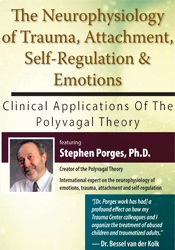
The Neurophysiology of Trauma, Attachment, Self-Regulation & Emotions: Clinical Applications of the Polyvagal Theory
- Speaker:
- Stephen Porges, PhD
- Duration:
- 5 Hours 59 Minutes
- Format:
- Audio and Video
- Copyright:
-
Apr 08, 2016
- Product Code:
- POS042910
- Media Type:
- Digital Seminar - Also available: Digital Seminar | DVD

Description
- Are the trauma, attachment and self-regulation interventions you use based on an outdated understanding of the neurophysiology?
- Is your treatment model rooted in an understanding of client arousal based on traditional maeasures without incorporating concepts from the Polyvagal Theory?
- During therapy sessions, are you aware that you and your client are responding to each other’s physiological state?
- Are your interactions with your clients missing an understanding of how mental processes influence physiology and how physiology influences cognitive, emotional, and social behavior?
If you aren’t consciously monitoring your client’s facial features and vocal intonation, you could be missing important cues of the social engagement system and therapeutic opportunities.
Dr. Stephen Porges is an recognized professional on the neurophysiology of emotions, trauma, attachment and self regulation. He will show you how you can put this understanding to use when implementing interventions for mediating symptoms of many mental health disorders including autism, depression, ADD and PTSD. In addition, learn strategies to trigger states of safety in your clients by activating the “highest level” mechanism.
Credit
Speaker
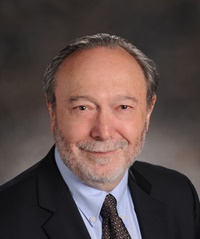
Stephen Porges, PhD Related seminars and products
Kinsey Institute, Indiana University and Department of Psychiatry at the University of North Carolina- Chapel Hill
Stephen W. Porges, PhD, is a distinguished University Scientist at Indiana University, where he is the founding director of the Traumatic Stress Research Consortium within the Kinsey Institute. He holds the position of Professor of Psychiatry at the University of North Carolina and Professor Emeritus at the University of Illinois at Chicago and the University of Maryland, and is a founder of the Polyvagal Institute. Dr. Porges served as president of both the Society for Psychophysiological Research and the Federation of Associations in Behavioral & Brain Sciences and is a former recipient of a National Institute of Mental Health Research Scientist Development Award. He has published approximately 400 peer-reviewed scientific papers across several disciplines including anesthesiology, biomedical engineering, critical care medicine, ergonomics, exercise physiology, gerontology, neurology, neuroscience, obstetrics, pediatrics, psychiatry, psychology, psychometrics, space medicine, and substance abuse. His research has been cited in more than 50,000 peer-review publications. In 1994, Dr. Porges proposed the Polyvagal Theory, a theory that links the evolution of the mammalian autonomic nervous system to social behavior and emphasizes the importance of physiological state in the expression of behavioral problems and psychiatric disorders. The theory is leading to innovative treatments based on insights into the mechanisms mediating symptoms observed in several behavioral, psychiatric, and physical disorders.
He is the author of The Polyvagal Theory: Neurophysiological foundations of Emotions, Attachment, Communication, and Self-Regulation (Norton, 2011), The Pocket Guide to the Polyvagal Theory: The Transformative Power of Feeling Safe (Norton, 2017), Polyvagal Safety (Norton, 2021), co-author with Seth Porges of Our Body Polyvagal World (Norton, 2023), and co-editor with Deb Dana of Clinical Applications of the Polyvagal Theory: The Emergence of Polyvagal-Informed Therapies (Norton, 2018). Dr. Porges is also the creator of a music-based intervention, the Safe and Sound Protocol™, which currently is used by approximately 3,000 therapists to improve spontaneous social engagement, to reduce hearing sensitivities, and to improve language processing, state regulation, and spontaneous social engagement.
Speaker Disclosures:
Financial: Dr. Stephen Porges is a Courtesy Professor with the University of Florida College of Medicine, a Distinguished University Scientist of Indiana University, and a Professor with the University of North Carolina. He receives royalties as a published author. Dr. Porges is co-owner of Polyvagal Music, LLC. He receives a speaking honorarium, book royalties, and recording royalties from PESI, Inc. He receives royalties and is a stockholder with integrated Learning Systems/Unyte.
Non-financial: Dr. Stephen Porges is an emeritus member of the American Psychological Association, the Association for Psychological Science, and the Society for Psychophysiological Research. He holds a patent on Televagal equipment.
Alternate Options
|
Clinical Applications of the Polyvagal Theory with Stephen Porges, PhD
Copyright: 07/15/2022 - Product Code POS042910 |
Additional Info
Access for Self-Study (Non-Interactive)Access never expires for this product.
Target Audience
Counselors, Social Workers, Psychologists, Case Managers, Addiction Counselors, Therapists, Marriage & Family Therapists, Nurses, Other Mental Health ProfessionalsObjectives
- Characterize the principle features and foundation of the Polyvagal Theory.
- Articulate how the Polyvagal Theory may explain behavioral features related to psychiatric disorders and other behavioral problems.
- Determine how maladaptive behaviors, which may accompany several psychiatric disorders, may reflect adaptive responses triggered by survival mechanisms.
- Communicate how the neural process (neuroception) evaluates risk in the environment and triggers adaptive neural circuits promoting either social interactions or defensive behaviors.
- Appraise the definition of the features of the Social Engagement System to include the neural pathways that connect the brain, face, and heart.
- Illustrate how deficits in the regulation of the Social Engagement System are expressed as core features of several psychiatric disorders.
- Specify how therapeutic presence is based on the interaction between the Social Engagement Systems of client and therapist.
- Evaluate how the Social Engagement System is involved in optimizing therapeutic outcomes.
- Ascertain which features of the Social Engagement System are compromised by stress and trauma.
- Determine how acoustic stimulation, via the Safe and Sound Protocol, may function as an acoustic vagal nerve stimulator to shift autonomic state and facilitate spontaneous social engagement behaviors.
Outline
The Polyvagal Theory- The principles and features of the Polyvagal Theory and how to apply it in a clinical setting
- How the Polyvagal Theory can demystify several features related to stress-related illnesses and psychiatric disorders such as PTSD, autism, depression, and anxiety
- How the Social Engagement System is compromised by stress and trauma and how to reset it
- Evolutionary changes and adaptive functions in the autonomic nervous system
- Humans response hierarchy to challenges
- Three neural platforms that provide the neurophysiological bases for social engagement, fight/flight, and shutdown behaviors
- A description of the “face-heart” connection that forms a functional social engagement system
- How our facial expressions, vocalizations, and gestures are regulated by neural mechanisms that are involved in regulating our autonomic nervous system
- How our social and physical environment triggers changes in physiological state
- Understanding that adaptive physiological reactions may result in maladaptive behaviors
- Immobilization without fear
- Play as a neural exercise
- Listening as a neural exercise
- Fight/flight and immobilization defense strategies
- Adaptive function of immobilization and the associated clinical difficulties
- How the stresses and challenges of life distort social awareness and displace spontaneous social engagement behaviors with defensive reactions
- Understanding auditory hypersensitivities
- State regulation as a core feature of psychiatric disorders
- Deconstructing features of autism and PTSD
- Strategies to explain disruption and repair of symbiotic regulation
- Identifying social cues that disrupt or repair defensive reaction
Reviews
| 5 |
|
| 4 |
|
| 3 |
|
| 2 |
|
| 1 |
|
Overall: 4.9
Total Reviews: 54
Satisfaction Guarantee
Your satisfaction is our goal and our guarantee. Concerns should be addressed to: PO Box 1000, Eau Claire, WI 54702-1000 or call 1-800-844-8260.
ADA Needs
We would be happy to accommodate your ADA needs; please call our Customer Service Department for more information at 1-800-844-8260.
PESI Mobile App
Access CE trainings on your phone or tablet through our free mobile app. Choose video or audio-only versions of online courses from the world’s best instructors, and complete your CE requirements anywhere, anytime, at your own pace.




Please wait ...