
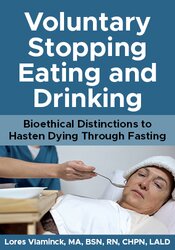
Voluntary Stopping Eating and Drinking: Bioethical Distinctions to Hasten Dying Through Fasting
- Speaker:
- Lores Vlaminck, MA, BSN, RN, CHPN, LALD
- Duration:
- 2 Hours 03 Minutes
- Format:
- Audio and Video
- Copyright:
-
Sep 27, 2024
- Product Code:
- POS078863
- Media Type:
- Digital Seminar

Description
Since health care staff may be faced with patient requests for information and support in their pursuit of Voluntary Stopping Eating and Drinking (VSED), many organizations are developing education, policies, and information for their staff and volunteers. Ethical differences exist not only with staff but possibly with family members. Some may view a plan to intentionally hasten dying by fasting as an act of suicide that should be discouraged; others may regard VSED as an ethically appropriate decision to forego undesirable life-prolonging measures.
Terminally ill patients may grow weary of the symptoms of an advanced disease for which they explore ways in which their death could come sooner. VSED is not to be confused with the natural progression of an advanced illness that occurs as part of the dying process. This session will explore ethical decision-making frameworks and the potential for ethical conflicts in the request for VSED.
Credit
Handouts/Brochure
| File type | File name | Number of pages | |
|---|---|---|---|
| Manual - Voluntary Stopping Eating & Drinking (1009.4 KB) | 28 Pages | Available after Purchase |
Speaker
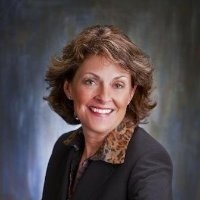
Lores Vlaminck, MA, BSN, RN, CHPN, LALD Related seminars and products
Owner
Lores Consulting
Lores J. Vlaminck, MA, BSN, RN, CHPN, LALD
Principal, Lores Consulting, LLC
Lores Consulting, LLC has been a leading provider of consulting, training, and mentoring for hospice, assisted living, home care and related health care providers for the past 17 years. "Lores has the heart of a teacher, and her passion is to support others in the hospice, palliative, and the home care industry."
Lores Consulting, LLC provides providers with education training and mentoring as well as mock surveys, agency analysis and audits. Drawing on her 45 years of nursing experience, Lores seeks to empower all her client providers to utilize their skills and expertise to reach their greatest potential. Her extensive nursing background includes clinical practice in cardiac and intensive care, outpatient clinic services, as well as serving as a home care and hospice administrator/director for 19 years in greater Minnesota.
In addition to being a certified hospice and palliative care nurse, Lores is also a trainer for the End-of-Life Nursing Education Consortium (ELNEC) curriculum that encompasses palliative and hospice care. She was named the "2010 Geriatric ELNEC Educator of the Year" by ELNEC.
Speaking topics include end-of-life care, grief and loss, compassion fatigue, professional boundaries, pain and symptom management, and many health and employee related topics. Lores also offers national, international consulting and mentoring services – encompassing education, training and compliance evaluations – to hospice and home care agencies, assisted living providers, and long-term care facilities.
As Principal of Lores Consulting, LLC, Lores sees her company’s mission to coach and encourage care providers to work to the ‘top of their license’ to ensure excellence in their delivery of care.
Currently, Lores serves as a board member of three non-profit health care organizations, and is a national speaker for PESI Healthcare and ELNEC. Lores is a graduate of Bethel University in St Paul, MN and holds a Bachelor of Science degree in nursing, as well as a master’s degree in nursing education.
Speaker Disclosures:
Financial: Lores Vlaminck receives compensation as an independent consultant, coach, and educator. She receives a speaking honorarium and recording royalties from PESI, Inc. She has no relevant financial relationships with ineligible organizations.
Non-financial: Lores Vlaminck is a member of the American Association of Palliative Medicine, the Minnesota Network for Hospice and Palliative Care, the National Hospice and Palliative Care Organization, and the National Hospice and Palliative Care Nurses Association.

Additional Info
Access for Self-Study (Non-Interactive)Access never expires for this product.
For a more detailed outline that includes times or durations of time, if needed, please contact cepepesi.com
Questions?
Visit our FAQ page at www.pesi.com/faq or contact us at www.pesi.com/info
Objectives
- Evaluate answers to VSED legal, ethical and clinically relevant questions.
- Determine management strategies for symptom burden of VSED.
- Develop education, policies, and position statements for VSED.
- Address the potential for conflicts between the patient’s choices and family dissention regarding VSED.
Outline
What is Voluntarily Stopping of Eating and Drinking (VSED)?A competent individual deciding to stop taking hydration and nutrition with the intention of hastening death. This is different from the loss of appetite that occurs during the transition phases of a terminal illness.
What VSED is NOT
- For everyone
- Withholding food/fluid
- Advisable if unsupported
- A rapid death
- Painful
- ”Starving to death”
- Symptom burden
- Expected duration
- Exploration of the cultural and emotional importance of eating and drinking
- Healthcare directives
- Hospice agencies
- Attending clinician
- Thirst
- Dehydration
- Incontinent
- Weakness
- Agitation/delirium
- Oral care needs
- Confusion
- Unconsciousness
- Who is the caregiver?
- Does the family/caregiver support the decision?
- Does the facility (if applicable) support the decision?
- What about medications?
- Is the medical provider supportive of the decision?
- Is VSED legal?
- Can I/we support a VSED request?
- What education will facility/agency provide to the client/family?
- What education will staff/volunteers need?
- What policies need to be developed or reviewed/revised?
- Will our agency/facility take a position of “non-participation and non-interference?”
- How will our agency/facility support a VSED request?
- How will we support staff/volunteers who have a conscientious objection to VSED?
- Legal in US
- ANA, AAHPM, IAHPM consider VSED legal option for terminally ill patients
- Autonomy vs Non-maleficence? (Hastening death, immoral act?)
- Autonomy vs Justice? (Hospice-qualifications for terminal prognosis without VSED?)
- Veracity vs. Confidentiality?
- Family fractures?
- Different than MAiD?
Target Audience
- Nurses
- Nurse Practitioners
- Clinical Nurse Specialists
- Physician Assistants
- Physical Therapists
- Physical Therapist Assistants
- Occupational Therapists
- Occupational Therapy Assistants
- Speech-Language Pathologists
- Social Workers
- Physicians



Reviews
Satisfaction Guarantee
Your satisfaction is our goal and our guarantee. Concerns should be addressed to: PO Box 1000, Eau Claire, WI 54702-1000 or call 1-800-844-8260.
ADA Needs
We would be happy to accommodate your ADA needs; please call our Customer Service Department for more information at 1-800-844-8260.
PESI Mobile App
Access CE trainings on your phone or tablet through our free mobile app. Choose video or audio-only versions of online courses from the world’s best instructors, and complete your CE requirements anywhere, anytime, at your own pace.




Please wait ...